Product knowledge popularization
A construction equipment supplier of construction machinery solutions for 30 years. WhatsApp:+86-18968212829
Language
A construction equipment supplier of construction machinery solutions for 30 years. WhatsApp:+86-18968212829
When engineers and site supervisors discuss concrete mixer capacity, the conversation often starts in the wrong place. Many buyers look first at the published drum volume, then jump straight to engine type or selling price. On site, that sequence causes trouble. Capacity is not the number printed on the drum; it is the amount of concrete a mixer can turn, discharge and repeat at a stable rate without segregation, excessive spill, motor overload or crew idle time.
A more reliable starting point is the job itself: how much concrete must be placed per hour, how stiff the mix needs to be, how far the mixer must be moved, whether mains power is available, and whether the machine can remain stable on the ground conditions actually found on site. Across current ranking guides, one repeated point is that stated drum volume and usable batch capacity are not the same figure; published guidance commonly places effective batch capacity somewhere well below nominal drum volume, often around half to roughly four-fifths depending on mixer type and mix characteristics.
Manufacturers publish drum volume because it is simple to state. Site crews care about usable output because that is what affects pour continuity.
A mixer drum needs free internal space for the material to tumble, fold and re-enter the mixing zone. If the drum is filled too high, three things happen quickly:
the aggregate no longer circulates properly;
the material climbs the shell and drops in lumps rather than remixing evenly;
discharge becomes slow and messy, especially with lower-slump mixes.
That is why many technical guides separate total drum volume from batch capacity or yield. Several current sources describe practical batch capacity as materially lower than the headline drum size, with examples such as a 350 L drum delivering around 250 L of mixed output, or a portable mixer producing roughly half to 70–80% of stated volume depending on the machine and the stiffness of the mix.
From a field engineering perspective, the safer rule is this:
If a team needs 1.2 m³ per hour and the mixer can only discharge 0.18–0.22 m³ per batch under the actual mix and site conditions, then the decision is no longer about drum size in isolation. It becomes a cycle-time problem.
The common mistake is to match mixer size to total project volume. The better method is to match it to required hourly placement rate.
A practical selection sequence is:
For example, a crew may need to place:
a small slab section before finishing begins,
footing concrete before reinforcement congestion slows access,
a kerb or paving run before the previous section starts to stiffen.
This is not a catalogue number. It depends on:
loading method,
number of labourers,
water measurement discipline,
travel distance from mixer to pour,
discharge arrangement,
cleaning interruptions.
That gives a target discharged volume per batch.
Real sites do not behave like laboratory schedules. If the calculation says a crew needs 0.20 m³ every batch, a machine that only manages 0.20 m³ in clean, level, well-powered conditions is already undersized.
Current top-ranking sizing pages often recommend starting from total required volume and batch frequency rather than from label size alone. That general direction is sound, but many stop before discussing what reduces actual batch rate on site: stiff mixes, uneven ground, poor loading sequence, and long transport distance from mixer to formwork.
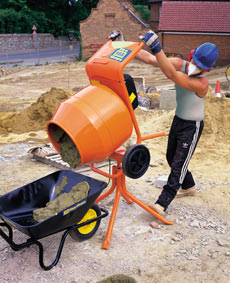
Portable drum mixers occupy an awkward but useful position. They suit repeated small pours, repair work, blockwork support concrete, footings, patch slabs, edging and light commercial work where ready-mix access is inconvenient or the required volume is too small to justify a truck.
Their limitation is not merely total yield. It is yield under repetition.
On a portable mixer, the realistic batch is shaped by four interacting factors:
A wet, highly workable mix may rotate and discharge easily at a higher fill percentage. A stiffer structural mix with larger aggregate will reduce the volume that can be mixed evenly. Some specialist guidance notes that stiff mixes can reduce usable volume sharply compared with more fluid mixes.
Poorly graded aggregate tends to bridge and segregate more readily in small drums. Large stone also reduces free movement in a compact mixer, especially when the blades are shallow or worn.
Bagged materials loaded by hand introduce irregular timing and often irregular water addition. That makes nominal batch size less relevant than repeatability.
A machine that manages one acceptable batch every now and then may struggle when required to run for two or three continuous hours. Motor heat, belt slip, bearing temperature and operator fatigue start to affect output.
For this reason, a buyer comparing 120 L, 160 L and 190 L class mixers should not ask only, “How much fits in the drum?” The better question is, “How much concrete can this unit discharge every 10 to 15 minutes for the full shift without drift in consistency?”
No. A larger mixer increases theoretical output, but it also changes the operating envelope.
A drum that is too large for the crew may create:
longer loading time per batch,
poorer water control,
slow manual discharge handling,
more dead time between batches,
higher push force and worse manoeuvrability,
more instability when moved across rough ground.
A small contractor pouring short runs of paving or intermittent footings can lose time with a mixer that outscales the labour pattern. By contrast, a mixer that is modestly smaller but easy to reposition, level and reload may deliver a higher net hourly output.
This is why some long-standing guides roughly associate smaller 60 L class machines with occasional small work and 120–190 L classes with more frequent medium-site use, especially where regular electricity is available. The broad sizing idea is useful, but on its own it is too coarse for engineering decisions. Crew rhythm and transport path matter just as much.