A construction equipment supplier of construction machinery solutions for 30 years. WhatsApp:+86-18968212829
Language
A construction equipment supplier of construction machinery solutions for 30 years. WhatsApp:+86-18968212829
Compare tracked and wheeled mini dumpers for mud, slopes and narrow sites. See how ground pressure, payload, speed and upkeep affect your choice.
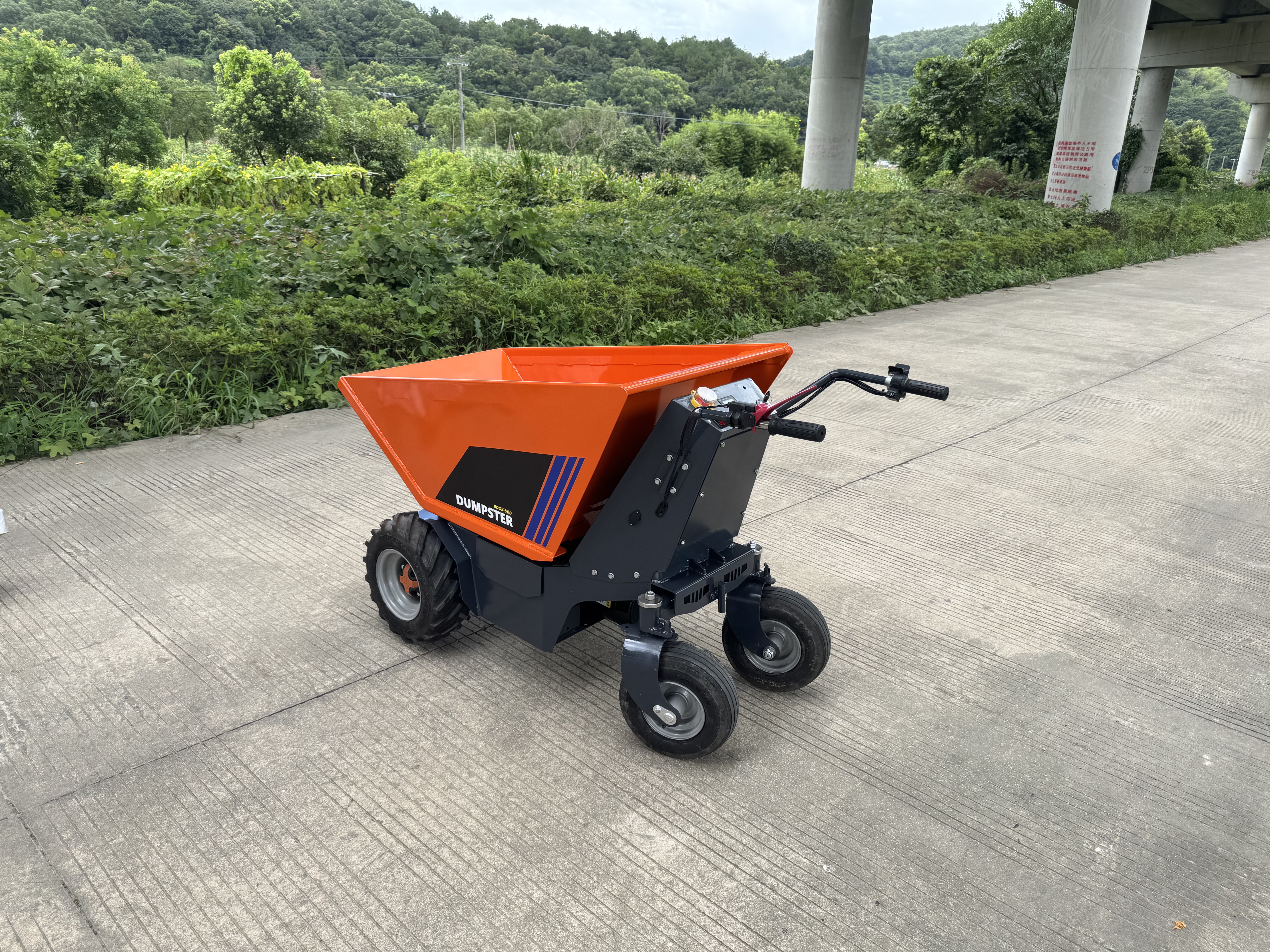
Choosing between a tracked and wheeled mini dumper should start with the route the machine will travel, not with the first specification sheet that lands in your inbox. Tracks spread the machine’s weight over a larger contact area, which can reduce sinking on soft or wet ground. Wheels usually roll more freely on firm surfaces and involve fewer undercarriage components. However, neither layout automatically offers the highest payload, the narrowest body or the lowest operating cost.
The better machine is the one that completes the required number of safe, fully loaded trips on your actual site. A tracked dumper may keep working when mud turns a wheeled route into a recovery exercise. On smooth concrete, a wheeled dumper may complete more cycles while the tracked model is still making its steady return to the loading point. The site conditions usually settle the argument faster than the sales brochure.
| Site condition | Likely starting point | What to check |
|---|---|---|
| Wet soil, mud or loose sand | Tracked mini dumper | Loaded ground pressure, track width and clearance |
| Concrete, asphalt or compacted stone | Wheeled mini dumper | Travel speed, tyre grip and route length |
| Rough landscaping route | Tracked mini dumper | Machine width, turning method and surface condition |
| Long, level haul route | Wheeled mini dumper | Payload multiplied by completed trips per hour |
| Narrow gate or doorway | Either type | Overall width, length, turning space and skip overhang |
| Raised skip or trailer loading | High-tip configuration | Tipping height and stability during unloading |
Tracks can reduce ground pressure, but the useful figure is the pressure with the machine fully loaded. Yanmar lists its C08-A Power tracked dumper at 0.20 kg/cm² when unloaded and 0.48 kg/cm² when loaded. The self-loading version increases from 0.23 to 0.52 kg/cm². In both cases, adding the working load more than doubles the published pressure.
This matters because an empty tracked dumper may cross a lawn without leaving much evidence, while the same machine with a full skip can produce a very different result. The C08 also carries up to 800 kg and uses 180 mm-wide tracks, showing why payload, contact area and ground condition must be considered together.
Wheels place the load through smaller tyre contact patches, but that is not always a disadvantage. On firm ground, they can reduce rolling resistance and shorten the travel part of each cycle. As one practical example, Muck-Truck publishes a 250 kg load capacity, a width of 710 mm and a maximum speed of about 5.6 km/h for one of its wheeled mini dumpers. Those figures do not represent every wheeled dumper, but they explain why a light power barrow can work efficiently on paved or compacted routes.
A tracked mini dumper is usually the safer starting point when tyres are likely to sink, slip or lose steering control. The longer contact area distributes the load and helps the machine stay in contact with uneven ground. Even so, buyers should compare loaded ground pressure, track width and ground clearance. Rubber tracks are useful, but they are not magic carpets.
The ACE HDCX-600 tracked mini dumper combines a 600 kg rated payload with two-speed travel and a high-tip height of approximately 1.45 m. That unloading height can be useful when material must go directly into a skip, trailer or raised container. It may remove an extra handling stage, although the skip should remain lowered while the machine is travelling. A raised load and uneven ground are rarely good friends.
A tracked mini dumper for landscaping can reduce rutting on damp soil, provided the operator avoids sharp pivot turns that scrape the surface. Machine width is also important, but it does not tell the whole access story.
Wacker Neuson lists its DT08 tracked dumper at 790 mm wide, with an 800 kg maximum payload and a top speed of 4 km/h. The manufacturer also publishes a theoretical gradeability of 36% and a maximum inclined position of 20 degrees. These limits apply to that model and should not be copied to another machine, especially when the skip is loaded or raised.
Optional equipment can also change how the machine behaves in confined areas. The standard Yanmar C08 is 810 mm wide and approximately 1,930 mm long, while the self-loading version is 835 mm wide and around 2,595 mm long. The loader adds only 25 mm to the width but roughly 665 mm to the length. In other words, the machine may pass through the gate and then discover that the corner behind it has other plans.
A wheeled dumper for a flat construction site becomes attractive when the route is firm, reasonably long and free from deep ruts. The lighter Muck-Truck example weighs about 135 kg unloaded and travels at up to 5.6 km/h. By comparison, the tracked DT08 has an operating-weight range of 595–710 kg and a maximum speed of 4 km/h.
This is not a direct performance test because the machines have different payloads and designs. It does show why transport weight and travel speed should be compared alongside carrying capacity. A larger machine may move more material per trip, while a smaller machine may be easier to load, transport and turn around.
A mini dumper load capacity comparison should always include cycle time:
Hourly material output = payload per trip × completed trips per hour
Consider a hypothetical example. A 600 kg tracked dumper completing three cycles moves 1,800 kg per hour. A 250 kg wheeled dumper completing eight cycles moves 2,000 kg. On that firm route, the smaller wheeled machine moves slightly more material. If mud reduces it to three completed cycles, however, its output drops to 750 kg per hour.
| Hypothetical example | Payload | Completed cycles | Calculated output |
|---|---|---|---|
| Tracked dumper on suitable ground | 600 kg | 3 | 1,800 kg/h |
| Wheeled dumper on a firm route | 250 kg | 8 | 2,000 kg/h |
| Wheeled dumper slowed by mud | 250 kg | 3 | 750 kg/h |
The calculation is not a field test. It simply shows why payload and top speed should never be judged separately. Loading time, tipping time, route length, turning space and waiting time at the excavator all belong in the same productivity calculation.
A tracked undercarriage includes rubber tracks, sprockets, rollers and a tensioning system. Packed mud should be removed, track tension checked and the rubber inspected for cuts or exposed reinforcement. Repeated pivot turns on abrasive concrete can also increase wear, so a compact tracked dumper should not be operated like a spinning office chair.
A wheeled dumper avoids many of these undercarriage components, but tyres can puncture, lose pressure or wear unevenly. Bearings, chains, axles, brakes and steering parts still require attention. There is no reliable universal percentage showing that wheels always cost less to maintain. Local parts availability, operator habits, working hours and surface conditions usually matter more than a simple tracks-versus-wheels label.
Choose a tracked mini dumper when soft ground, uneven routes, slopes and regular outdoor use dominate the schedule. Choose a wheeled mini dumper when the route is firm, travel distances are longer and simple tyre servicing is valuable. For a mini dumper for a narrow-access site, measure the entire route rather than only the entrance.
Before ordering, compare loaded ground pressure, payload, overall width, machine length, travel speed, gradeability, ground clearance, tipping height and service access. The correct machine is the one that completes the required cycles without getting stuck, damaging the surface or creating unnecessary downtime.
Tracked models are generally better suited to soft, muddy and uneven ground. Wheeled models can be more productive on firm routes where travel speed and lower transport weight reduce cycle time.
No. Payload depends on the chassis, engine, hydraulics, brakes and skip structure. Tracks improve ground contact, but they do not create carrying capacity by themselves.
A tracked dumper can apply lower ground pressure, although sharp pivot turns may disturb turf. A light wheeled machine may cause less damage on dry, firm ground, so loaded weight and steering method both matter.
Wheeled machines normally have fewer undercarriage wear components. Tracked machines may still offer a lower operating cost on difficult sites when their traction prevents delays, recovery work and interrupted transport cycles.
Contact Us
Get In Touch With US
If you have more questionswrite to us, tell us your requirements, we can do more than you can imagine.
Recommended
 +86-18968212829

