Product knowledge popularization
A construction equipment supplier of construction machinery solutions for 30 years. WhatsApp:+86-18968212829
Language
A construction equipment supplier of construction machinery solutions for 30 years. WhatsApp:+86-18968212829
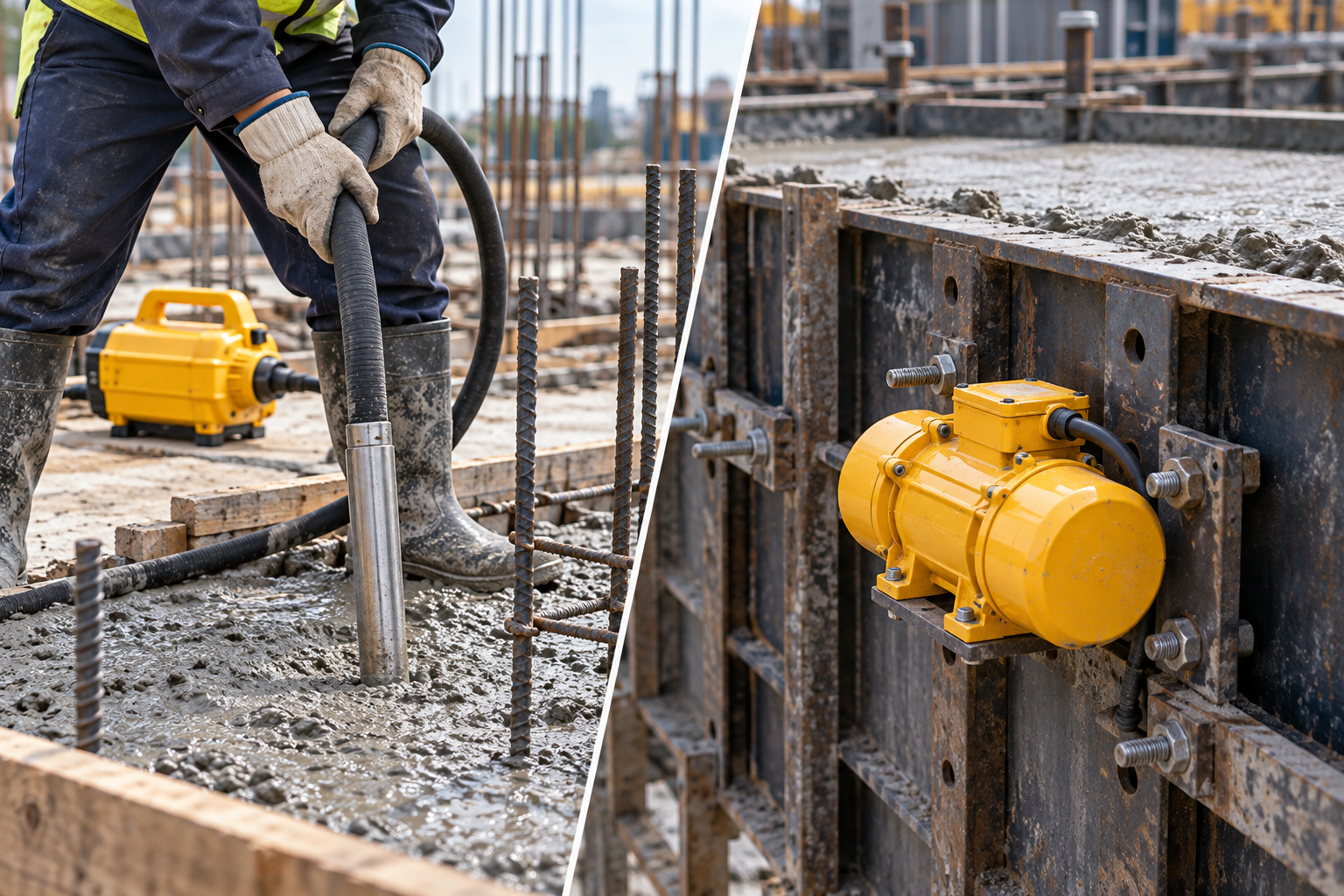
Choosing between internal vs external concrete vibrators comes down to a simple question: how can you get enough vibration into the concrete without making the job harder than it needs to be? When a poker can pass through the reinforcement and reach the fresh concrete, internal vibration is usually the natural starting point. If that access is limited, a suitably mounted external vibrator may be a better way to reach the areas that need consolidation.
Both methods help fresh concrete settle around reinforcement, fill the form and release trapped air. The difference is how the vibration gets there. An internal vibrator works directly inside the mix, while an external vibrator sends vibration through the formwork or mould.
That difference affects more than the equipment you buy. It changes how you plan the pour, prepare the formwork, position the operator and check the finished concrete. For contractors, precast manufacturers and equipment dealers, understanding these practical details makes choosing the right machine much easier.
The two machines perform the same general task, but they take different routes to get there. An internal vibrator places the vibrating head directly into the concrete. An external vibrator stays outside the form and relies on the formwork to carry the movement into the mix.
This sounds like a small distinction until you encounter a heavily reinforced column or a thin precast mould. In one situation, a poker gives you direct access to the concrete. In the other, there may be nowhere to insert it safely. That is where the choice of vibration method starts to matter.
An internal vibrator, also called an immersion or poker vibrator, uses a vibrating head attached to a drive system. The operator lowers the head into the fresh concrete, lets the vibration help the mix settle and then moves to the next insertion point.
Because the head works inside the concrete, the operator can target different areas of a wall, column or foundation. This approach is particularly useful when reinforcement spacing and access allow the poker to move freely.
An external concrete vibrator, sometimes called a form vibrator, is fixed to a suitable bracket or mounting point outside the form. Its vibration travels through the mounting assembly and formwork before reaching the concrete.
This method is useful where internal access is restricted. It is also common in precast production, where reusable moulds can be prepared with planned vibration points.
There is one catch: the formwork now becomes part of the equipment system. If the mounting is poor or the form moves too freely, the motor may spend more energy shaking the form than consolidating the concrete.
| What to Compare | Internal Vibrator | External Vibrator |
|---|---|---|
| How vibration reaches the concrete | Directly through an immersed poker | Through the formwork or mould |
| Access needed | A clear path between reinforcement | Suitable external mounting points |
| Common applications | Foundations, beams, columns and walls | Precast moulds, thin sections and restricted-access forms |
| Main limitation | Poker cannot reach every area | Formwork may not transmit vibration effectively |
| Equipment to check | Head diameter, shaft length and drive | Motor, brackets, form stiffness and electrical supply |
| Typical maintenance items | Poker, flexible shaft, coupling and seals | Fixings, bearings, mounts and electrical components |
The American Concrete Institute's guidance on concrete consolidation recognises internal vibration, external vibration and combinations of both. The correct method should suit the concrete mix, reinforcement, formwork and placement conditions.
For many ordinary structural pours, an internal concrete vibrator is the first machine worth considering. It brings vibration directly to the fresh concrete, and the operator can adjust the insertion pattern as the placement progresses.
This flexibility is useful on building sites, where pour dimensions and reinforcement layouts change from one section to another. However, the poker still needs room to work.
Internal poker vibrators are widely used for columns, beams, foundations and walls where the head can reach the required depth. By working systematically through the pour, the operator can help the concrete settle around bars and embedded items.
Insertion spacing and vibration time should follow the equipment performance and the concrete's actual response. The aim is to achieve overlapping areas of consolidation, rather than leaving untreated gaps between insertion points.
ACE discusses these practical checks in its concrete vibrator spacing and vibration time guide.
A larger poker can influence more concrete around each insertion, but only if it can enter the form. Dense reinforcement, narrow walls and complicated embedded parts may restrict the available route.
In these situations, a smaller poker may solve the problem. The trade-off is that a smaller head often needs more insertion points to cover the same area.
Before selecting a head, measure the reinforcement clearance and check the working depth. The ACE concrete vibrator poker size guide explains how to balance head diameter, working radius and flexible shaft reach.
Sometimes even a smaller head cannot reach the necessary areas. This may happen in thin sections, dense reinforcement cages or forms containing numerous embedded components.
Forcing the poker between bars is not a good solution. It may damage equipment, disturb reinforcement or prevent the operator from following a proper insertion pattern. A concrete vibrator is a consolidation tool, not a crowbar.
When the access problem cannot be solved through equipment selection or placement planning, it is time to assess whether external vibration is suitable.
External vibration becomes useful when reaching the concrete from inside is difficult, or when a mould has been prepared specifically for vibration from outside. It is particularly relevant to some thin concrete sections and precast production processes.
That does not mean every heavily reinforced structure needs an external vibrator. The important question is whether the form can transmit enough vibration to the right areas without compromising its strength or stability.
Imagine a thin concrete wall with reinforcement on both faces. There may be enough space for concrete to flow into the form, but not enough room to move a poker through it properly.
An external vibrator may offer another way to consolidate that section. Instead of trying to squeeze a head between the bars, vibration enters through the formwork.
However, the form must be suitable for this method. The engineer or equipment supplier needs to consider panel stiffness, mounting points, concrete pressure and vibration distribution before installation.
Precast production is one of the clearest applications for external vibration. A factory often works with the same mould dimensions over many production cycles. This makes it possible to plan mounting points, electrical connections and vibration sequences in advance.
The real advantage is consistency. When the mould and vibration arrangement are properly matched, operators can follow a repeatable process rather than positioning a handheld poker differently for every cast.
That said, repeatable operation does not guarantee complete consolidation. A mould can still have areas where vibration is too weak or uneven. Production trials and quality checks remain necessary.
Yes. In some projects, an internal poker can consolidate the main concrete volume while external vibration helps reach difficult areas near the form surface or around complicated reinforcement.
The two methods should be planned as one process. Running every vibrator at once simply because the equipment is available can cause unnecessary agitation, uneven results or additional loads on the formwork.
The goal is to get the concrete properly consolidated, not to make the whole jobsite shake.
Here is the part of external vibrator selection that buyers sometimes overlook: you are not really buying just a motor. You are choosing a motor that must work with a particular formwork or mould system.
The form affects how vibration spreads, and the mounting arrangement affects how much of the motor's movement reaches the concrete. A poorly matched combination can create noise and movement without producing the consolidation the job requires.
Formwork already has to resist pressure from fresh concrete. Adding an external vibrator introduces further dynamic loading, which the panels, stiffeners, supports and connections must be able to withstand.
A reusable steel mould may have dedicated mounting points. A temporary form built for an ordinary pour may not. The second case should not be treated as suitable merely because there is enough space to fit a motor.
Before installing an external vibrator, confirm that the proposed mounting arrangement is approved for the formwork and the expected operating loads.
The motor needs a secure connection to the form so vibration can pass through the structure effectively. Depending on the equipment, installation may use approved brackets, bolts or clamps attached to suitable structural members.
Where the vibrator is mounted also matters. A poor location may cause one section of the form to vibrate strongly while another receives too little movement.
There is no single mounting distance that works for every external vibrator. Form dimensions, panel stiffness, concrete workability, motor output and the manufacturer's installation guidance all affect the arrangement.
Loose fasteners, damaged brackets, leaking form joints, uneven vibration and unwanted panel movement are all possible warning signs. Excessive or poorly distributed vibration can also affect the concrete finish.
The sensible approach is to inspect the mounting system before every production run and investigate unusual movement rather than assuming the motor simply needs more power.
For a useful overview of the different vibration methods, EXEN's technical guide to concrete vibrator types explains internal, external and vibrating-table equipment.
Even the correct equipment will behave differently in different concrete mixes. A stiff mix resists movement more strongly than a highly workable one, so the same vibration method may produce different results from one project to another.
This is why selecting a vibrator without considering the mix can lead to disappointing results. The structure determines where vibration can be applied, while the concrete determines how it responds.
Low-workability concrete generally needs sufficient vibration to reduce friction between the particles and help the mix settle into the available space. That does not automatically mean using an external vibrator or buying the most powerful motor in the catalogue.
If an internal poker has good access, it may still be the more direct approach. Where an engineered mould supports external vibration, that system may be suitable instead. The choice depends on both the mix and the construction method.
Highly workable concrete usually flows more readily around reinforcement and into corners. Excessive vibration may offer little benefit and can increase segregation risk in susceptible mixes.
Self-consolidating concrete is different again. It is proportioned to flow and consolidate under its own properties, normally without conventional mechanical vibration. Its handling should follow the approved mix and placement specification.
Frequency tells you how quickly vibration cycles occur. Amplitude describes the amount of movement during each cycle. Motor power describes electrical or mechanical input, not the full behaviour of the vibrator in concrete.
These numbers are connected, but they do different jobs. Two vibrators with similar motor power may behave differently because their vibration systems, installation methods and working conditions are not the same.
For a clearer explanation, see ACE's article on concrete vibrator frequency and amplitude.
Project type is a useful place to begin, but it should not be the final deciding factor. Two walls of the same thickness may need different equipment if their reinforcement layouts, concrete mixes or formwork systems are different.
The following table gives buyers a starting direction rather than a fixed rule for every construction project.
| Application | Start by Considering | What to Check First |
|---|---|---|
| Accessible wall or column | Internal poker vibrator | Rebar clearance, head size and shaft reach |
| Thin, heavily reinforced wall | Small internal poker or engineered external vibration | Actual insertion path and formwork suitability |
| Large foundation | Internal vibrators with planned insertion coverage | Pour depth, placement rate and working radius |
| Reusable precast mould | External or combined vibration | Mould stiffness, mounting positions and production cycle |
| Architectural concrete form | Internal, external or an approved combination | Concrete access, surface requirements and form design |
| Vibrating-table production | Purpose-built table vibration system | Table load, motor arrangement and mould compatibility |
If the answer still isn't clear, a controlled trial using the actual mix and formwork is often more informative than a general recommendation. The trial can show whether the proposed equipment reaches the whole section and produces a consistent finish.
Once the vibration method has been chosen, the next task is to select a complete equipment configuration. This is especially useful for overseas buyers because motors that look similar in photographs may have different electrical supplies, operating characteristics or connection systems.
Start with the poker diameter and the available space inside the form. Then check shaft length, drive-unit compatibility, vibration specifications and power supply.
For a contractor working on several types of structural concrete, choosing different poker sizes may be more useful than ordering a single large head for every job.
If the purchase includes replacement shafts, do not assume that a head of the right diameter will fit the existing drive unit. ACE's concrete vibrator shaft compatibility guide explains why couplings, shafts and drive systems need to be matched.
For external vibration, request the motor specification together with mounting dimensions and installation information. Buyers should confirm the electrical supply, rated operating conditions, force units, mounting pattern and compatible fixing components.
For a precast plant, it is also necessary to know how many units may be required, how they will be positioned and how the operators will control them during the production cycle.
Do not estimate these details from motor wattage alone. A 1.5 kW unit does not automatically cover a fixed area of formwork, and a larger motor is not a shortcut around proper installation planning.
Dealers supplying ordinary construction contractors may need several poker diameters, flexible shafts and drive options. Companies serving precast manufacturers may need more information about external motor selection, brackets, electrical controls and installation support.
Spare-parts planning differs as well. Internal systems involve pokers, flexible shafts and couplings, while external systems can require mounting hardware, electrical parts and motor service components.
For rental companies, a clear explanation of suitable applications is useful. An internal poker is relatively easy to move between job sites, while an external system often needs more preparation before it can be used correctly.
| Buying Question | Internal System | External System |
|---|---|---|
| Where is vibration applied? | Directly inside the concrete | Through a form or mould |
| Which dimensions matter? | Poker diameter and shaft reach | Motor mounting pattern and form geometry |
| What must be compatible? | Head, shaft, coupling and drive unit | Motor, mounting hardware, power supply and formwork |
| What affects productivity? | Insertion coverage and operator access | Vibration distribution and production sequence |
| What should buyers request? | Complete set specification and spare-parts list | Motor data, mounting requirements and control information |
ACE supplies both immersion and external concrete vibrator products. They belong to the same equipment family, but their published specifications should not be compared as if they perform the same task in the same way.
The ACE ZID-230C internal concrete vibrator has a published rated input of 2,300 W, a 220 V supply and a 50 Hz rated supply frequency. Its accompanying high-frequency poker range includes ZX-35, ZX-45 and ZX-50 options, each listed with a vibration frequency of 200 Hz.
The product table also lists an 18,000 r/min no-load motor speed. This figure describes motor rotation, while the 200 Hz value refers to the published poker vibration frequency. They should not be treated as interchangeable measurements.
For buyers, the practical checks remain poker diameter, shaft length, compatible drive components and the conditions of the concrete placement.
The ACE ZW external concrete vibrator range includes models from ZW-15 to ZW-100. The published specification table lists motor powers from 0.35 to 3.0 kW and provides speed, voltage, frequency and weight information for the different models.
However, the centrifugal-force figures on the current product page do not include a clearly stated unit. Some power information in the overview also differs from the model table. Buyers should therefore request the latest model-specific technical sheet before using these figures for engineering selection.
Installation details are equally important. The motor needs to work with the actual formwork and an approved mounting arrangement, so ordering by model name alone is not enough.
| ACE Equipment | Published Information | Main Selection Check |
|---|---|---|
| ZID-230C Internal Vibrator | 2,300 W; 220 V; ZX-35/45/50 poker options | Poker clearance, shaft reach and complete system compatibility |
| ZW External Vibrator Series | ZW-15 to ZW-100; 0.35–3.0 kW in the product table | Confirmed vibration output, mounting arrangement and electrical supply |
Contractors can explore the wider ACE concrete vibrator range, while buyers sourcing immersion equipment can also review the concrete vibrator shaft range for different working requirements.
Motor power matters, but it does not tell you whether the vibrator can reach the concrete or whether the formwork can carry the vibration. Select the working method first, then compare the relevant specifications.
An internal poker needs room to enter the mix. An external vibrator needs a suitable structure to transmit its movement. If either condition is missing, a larger motor is unlikely to solve the real problem.
External vibrators need approved mounting points, secure fasteners and a suitable formwork design. Attaching a motor to the nearest available panel is not a substitute for proper installation planning.
Supply frequency, motor speed and actual vibration frequency may all appear on the same data sheet. Check the units and the meaning of each figure before comparing models. This small habit can prevent a surprisingly large purchasing mistake.
For many conventional structural pours, an internal poker is the more practical starting point when there is enough access. An external vibrator becomes useful when internal access is limited or a suitable mould can transfer vibration effectively. The final decision depends on the concrete, reinforcement and formwork.
Consider external vibration for restricted-access concrete sections, thin forms or precast moulds where vibration can be transmitted through the structure. Before using it, confirm that the formwork, mounting system and equipment output are appropriate for the application.
In some approved construction and precast processes, yes. However, an external vibrator cannot replace a poker in every situation. It relies on the formwork to transfer vibration, so mounting, stiffness and vibration distribution must be considered before making the change.
Yes. External vibrators are widely used with suitable precast moulds and vibrating tables. They can support a repeatable production process, but the motor arrangement must match the mould construction, concrete mix and required production cycle.
Yes. Poor mounting, excessive vibration loads or weak formwork connections can cause loosening, leakage, deformation or equipment damage. The form and mounting system should be assessed before installation and inspected during production.
A poker vibrator is inserted directly into fresh concrete and applies vibration inside the mix. A form vibrator is mounted outside the formwork and transfers vibration through the form or mould. The two methods use different equipment arrangements and have different access requirements.
Yes, where the approved construction method allows it. The internal poker can consolidate accessible concrete, while external vibration may help in difficult areas. Their operation should be coordinated to avoid unnecessary vibration, uneven consolidation or excessive loads on the formwork.
The most useful starting point is not the largest motor in the catalogue. It is the concrete element itself. Check whether an internal poker can reach the mix, whether the formwork could support external vibration and how the concrete is expected to respond.
Once those questions are answered, it becomes easier to compare poker size, shaft length, electrical supply, mounting arrangements and spare-parts needs. Contractors can choose equipment that suits the pour, while dealers and precast manufacturers can make more informed decisions about the product configurations they stock.
When requesting an ACE concrete vibrator, share the element dimensions, reinforcement clearance, formwork details, concrete application and available power supply. That gives the supplier something useful to work with—and saves both sides from guessing what the biggest machine might be able to do.

