A construction equipment supplier of construction machinery solutions for 30 years. WhatsApp:+86-18968212829
Language
A construction equipment supplier of construction machinery solutions for 30 years. WhatsApp:+86-18968212829
Choosing the right concrete vibrator poker size is easier when you start with the concrete structure instead of the machine catalogue. The poker needs to be small enough to pass through reinforcement and reach the fresh concrete, but large enough to provide a useful working range and keep up with the pour.
In most cases, four questions will point you in the right direction. How tight is the reinforcement? How workable is the concrete? How deep is the section? And how much concrete does each insertion need to consolidate?
Once these points are clear, selecting the poker diameter, shaft length and drive system becomes much more straightforward.
A larger poker can cover more concrete around each insertion, but bigger is not always better. If a 60 mm head cannot pass through the reinforcement cage, its impressive diameter is not doing much useful work. At that point, it is mainly a very solid piece of steel waiting above the formwork.
This guide explains how contractors, rental companies, dealers and procurement teams can choose concrete vibrator head size and shaft length for real construction conditions, without confusing poker diameter with drive-unit compatibility.
Suggested image: Several concrete vibrator poker diameters arranged side by side with size labels.
The correct vibrator head size depends mainly on four things: available space around the reinforcement, concrete workability, the dimensions of the structural element and the radius of action you need.
Smaller poker heads are easier to move through congested reinforcement and narrow forms. Larger poker heads can influence a wider area of concrete when there is enough room to use them properly.
This is why simple rules such as “35 mm is for columns” or “50 mm is for foundations” are not very reliable. Two columns can have completely different reinforcement layouts, and two concrete mixes can respond differently to the same vibrator.
| Poker Size Class | Main Advantage | Main Limitation | Typical Selection Direction |
|---|---|---|---|
| Small diameter | Easier to pass through dense reinforcement | Smaller radius of action and more insertion points | Congested reinforced sections, narrow walls and smaller precast forms |
| Medium diameter | Good balance between access and coverage | Needs reasonable clearance around reinforcement | General reinforced-concrete work |
| Large diameter | Can influence more concrete per insertion | Heavier and harder to use in tight reinforcement | Open sections, larger footings and heavier concrete placements |
The key word here is selection direction. The exact poker still needs to match the concrete, structure and vibrator system being used.
Before looking at motor power, vibration frequency or shaft length, first check whether the poker can physically reach the concrete.
If the head cannot pass through the reinforcement cage, the rest of the specification sheet becomes much less important.
A concrete vibrator should be able to move through the reinforcement without being forced against steel bars, embedded parts or the formwork.
This matters especially in columns, beams, thin walls and heavily reinforced precast elements, where the available space can become much smaller as the poker moves deeper into the section.
For this reason, concrete vibrator head size and rebar spacing should always be considered together. A smaller poker gives the operator more freedom to reach difficult areas. A larger poker may provide better coverage, but only if there is enough room to position it correctly.
When reinforcement is closely spaced, a smaller poker is often the more practical option because it can move through the cage without getting trapped or repeatedly hitting the bars.
The trade-off is simple. A smaller head usually affects a smaller volume of concrete, so the operator may need more insertion points.
That does not mean the smaller poker is less effective. It simply means the insertion pattern needs to match the working range of the tool.
Suggested diagram: A small poker passing through dense reinforcement beside a larger head that cannot fit through the same opening.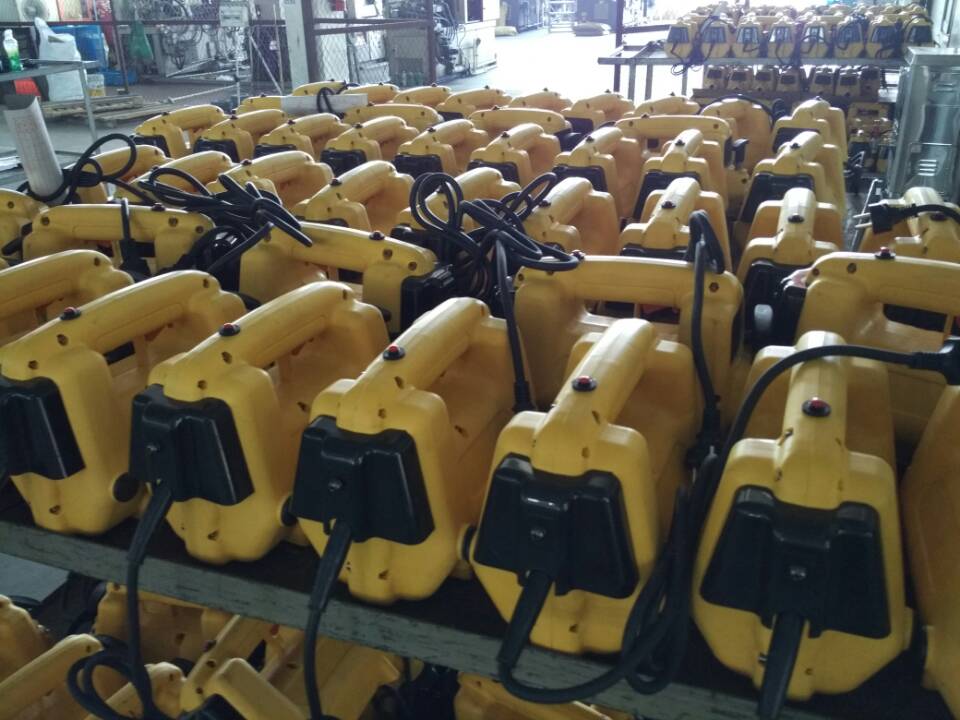
The radius of action is the area around the vibrator head where the fresh concrete is effectively influenced by vibration.
This matters because it helps determine how far apart each insertion point can be placed.
Poker diameter affects this working area, but it is not the only factor. Frequency, amplitude and concrete workability also affect how far vibration travels through the mix.
When two suitable vibrators are used in the same concrete, the larger poker will usually influence a wider area around the head.
This can reduce the number of insertion points and help the operator keep pace with a faster concrete pour.
That makes larger poker heads useful in bigger sections where there is enough clearance. On large foundations or open concrete placements, fewer insertions can save a lot of time over a full working day.
Whatever poker size you use, neighbouring vibration zones should overlap so that pockets of poorly consolidated concrete are not left between insertion points.
The real spacing should be based on the actual behaviour of the concrete rather than a fixed number copied from another job.
This is a useful lesson for equipment buyers. Poker diameter affects productivity, but the concrete itself still decides how far the vibration really works.
Suggested diagram: Three poker diameters with different overlapping working zones around each head.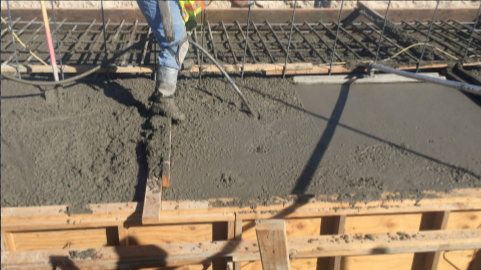
The same vibrator can behave very differently in two concrete mixes.
A stiff mix resists movement more strongly, while a more workable mix flows more easily around reinforcement and inside the form. This means poker diameter, frequency and amplitude need to work together rather than being judged separately.
Low-workability concrete needs enough vibration energy to reduce internal friction and help the particles settle into a denser structure.
This is one reason motor power alone is not a good way to choose a concrete vibrator. A larger motor number may look attractive on paper, but it does not tell you exactly how the poker behaves inside the concrete.
More workable concrete usually moves more easily around reinforcement and into corners.
That does not mean vibration is unnecessary, but excessive vibration can create problems if the mix is already very fluid. Holding the poker in one place for too long does not automatically improve the result.
The better approach is to match the vibration method to the actual mix rather than assuming that more vibration must always mean better concrete.
A 45 mm poker from one vibrator system should not automatically be treated as identical to every other 45 mm poker.
Different systems can use different frequencies, amplitudes, flexible shafts and couplings.
So poker diameter answers one question:
How large is the head?
It does not answer:
Will this shaft connect to my drive unit?
And it does not tell you whether two different vibrator systems will perform in the same way.
Once the poker diameter is selected, the next question is reach.
The flexible shaft needs to be long enough for the poker to reach every part of the concrete comfortably, but not so long that the operator spends the whole day wrestling with unnecessary extra shaft.
Floors, slabs and shallow concrete sections usually need less shaft length because the operator can work close to the surface.
A shorter shaft is lighter, easier to control and easier to move around the jobsite.
If you are compacting a shallow slab, carrying several extra metres of shaft rarely makes the job more impressive. It mainly gives the operator more equipment to drag around.
Walls, columns and deeper forms often need longer flexible shafts because the poker must reach further down into the concrete while the drive unit remains outside the formwork.
The shaft should be long enough to reach the lower sections comfortably. The operator should not have to stretch the equipment to its practical limit just to reach the bottom of the pour.
Extra shaft length adds weight and can make transport, handling and storage more difficult.
It also needs to remain within the correct vibrator system. ACE's X-series technical data, for example, includes flexible shafts from 1 m to 6 m, while other ACE vibrator systems use different shaft ranges.
This means shaft length should always be selected within the correct product family rather than treated as a universal accessory.
Suggested diagram: A shorter flexible shaft working on a slab beside a longer shaft reaching into a wall or column.
ACE publishes several concrete vibrator systems, and each system has its own poker size range.
For example, ACE's pendulum-system technical data includes 25, 35, 45, 50, 60 and 70 mm poker options. Other vibrator systems use different diameter combinations, so buyers should not assume that heads from different systems can be exchanged simply because the numbers look similar.
From a selection point of view, the main difference between these sizes is the balance between access and coverage.
| Poker Diameter Example | Main Selection Logic | What the Buyer Should Check |
|---|---|---|
| 25 mm | Useful where access is restricted | Rebar clearance, insertion spacing and compatible drive system |
| 35 mm | Offers more coverage while remaining relatively compact | Section size, reinforcement layout and concrete workability |
| 45 mm | Provides more coverage where space allows | Available clearance, placement speed and vibrator system |
| 50 mm | Larger head for sections with sufficient working space | Rebar spacing, handling weight and working radius |
This should be treated as a selection framework, not a fixed application chart.
A 35 mm poker is not automatically “the column size”, and a 50 mm poker is not automatically “the foundation size”. The structure and concrete conditions still decide whether the head is suitable.
Some ACE systems also include larger poker diameters, including 60 mm and 70 mm options in the published pendulum range.
These larger heads are more suitable where the concrete section is open enough to accept them and where a wider working area is useful.
However, the head and shaft assembly also becomes heavier as size increases. This affects operator handling, especially during long working periods.
For high-volume concrete placement, a larger poker can reduce the number of insertions. In a heavily reinforced section, though, a large head may never reach the area it was bought to consolidate.
Concrete is quite good at teaching buyers that the biggest tool is not always the smartest tool.
To understand vibrator performance properly, buyers should look at poker diameter, frequency and amplitude together.
Head diameter mainly affects physical access and the amount of concrete influenced around each insertion.
Frequency describes how quickly the vibrator cycles.
A higher frequency does not automatically mean better consolidation because frequency works together with amplitude, head size and concrete behaviour.
Amplitude describes how much vibratory movement occurs during each cycle.
It affects the way energy is transferred into the concrete and should not be judged separately from frequency.
ACE's high-frequency products show why this matters. Some published models operate at the same stated vibration frequency but use different poker diameters and amplitudes.
So buyers should compare the complete vibrator system rather than choosing equipment from one number alone.
Internal link: Link how frequency and amplitude affect concrete vibration to the dedicated ACE technical article.
Project type can help narrow the selection, but it should only be a starting point.
The final decision should still come from reinforcement clearance, section dimensions, workability and required reach.
Columns often combine deep forms with closely spaced reinforcement.
Start by checking the narrowest opening through the reinforcement cage. Then make sure the shaft is long enough to reach the lower part of the pour comfortably.
A smaller poker may be easier to position, but the operator may need more insertion points because the working radius is smaller.
Wall thickness and reinforcement layout have a major influence on poker size.
Thin walls and walls with reinforcement on both faces can restrict access, while thicker walls may allow a larger head.
For deep wall forms, shaft length becomes just as important as poker diameter.
For slabs and floors, the vibrator needs to match the slab thickness and reinforcement while remaining easy to move across the working area.
A shorter shaft often makes this type of work easier because the operator does not need excessive reach.
On large slab pours, productivity also matters because the vibration team needs to keep pace with concrete placement.
Footings and foundations often provide more room for a larger poker, but reinforcement, anchor bolts and embedded parts can still reduce the available space.
Where clearance is generous, a larger head can influence more concrete per insertion and reduce the number of insertion points.
Precast work often involves narrow moulds, dense reinforcement and repeated production cycles.
In this environment, reliable access and repeatable vibrator performance may matter more than simply choosing the largest poker available.
If an internal poker cannot reach the required area, external or form vibration may need to be considered instead.
For contractors and purchasing teams, the simplest way to choose the right vibrator is to ask the questions in the correct order.
| Step | Question | Why It Matters |
|---|---|---|
| 1 | What is the narrowest reinforcement or formwork clearance? | This sets the physical limit for poker diameter |
| 2 | How workable is the concrete? | This affects how the mix responds to vibration |
| 3 | How deep is the concrete section? | This helps determine the required shaft length |
| 4 | How much concrete must each insertion influence? | This connects poker size with productivity |
| 5 | Which poker diameter fits the available space? | This balances access and radius of action |
| 6 | What shaft length reaches the entire pour comfortably? | This avoids both insufficient reach and unnecessary weight |
| 7 | Is the poker and shaft compatible with the drive unit? | This prevents ordering parts that cannot work together |
The order is important.
Starting with motor power and checking rebar clearance at the end is backwards. The poker has to reach the concrete before any performance figure becomes useful.
A larger head can increase coverage, but only when there is enough space to use it properly.
If the poker cannot move through the reinforcement, the extra diameter becomes a disadvantage rather than an advantage.
Motor power is useful, but it does not describe the complete vibrator system.
Buyers should also compare poker diameter, vibration frequency, amplitude, shaft length and compatibility.
This is one of the easiest mistakes to avoid.
A poker that cannot reach lower parts of a reinforced section may leave poorly consolidated areas even when the motor itself is powerful enough.
Extra reach can be useful, but unnecessary shaft length makes handling more difficult.
Select enough length to reach the concrete comfortably rather than simply choosing the longest option in the catalogue.
Two poker heads with the same diameter may belong to completely different shaft and coupling systems.
Poker diameter tells you about head size. It does not tell you whether the part will connect to your existing vibrator drive.
Internal link: Link this paragraph to Concrete Vibrator Shaft Compatibility: A Buyer's Guide.
ACE supplies several concrete vibrator families, so the first step is to identify which system the buyer is using.
ACE's published technical data includes pendulum poker options from 25 mm up to 70 mm.
Each size has its own specifications for poker length, amplitude and frequency and should be matched with the correct flexible shaft and power source.
The ACE X-series uses a different size range.
Published data includes XP25, XP30, XP38, XP48 and XP58 poker heads. The same technical documentation separates compatible shafts into SXT and XT groups.
This is a useful reminder that choosing the correct poker size and checking mechanical compatibility are two separate tasks.
ACE also offers high-frequency electric vibrator systems with their own poker combinations.
For example, current ZID-230D technical data includes ZX-25, ZX-38, ZX-48 and ZX-58 options operating at a published 200 Hz frequency, while another ACE high-frequency product family uses ZX-35, ZX-45 and ZX-50 sizes.
These product families should not be mixed together when ordering replacement components.
Always work from the exact model data sheet.
Suggested infographic: Reinforcement clearance → poker diameter → shaft length → compatible ACE vibrator system.
Alt text: ace-concrete-vibrator-poker-and-shaft-selection
Start with the narrowest reinforcement and formwork clearance. Then consider concrete workability, section depth and the working radius you need. Smaller heads are easier to use in congested reinforcement, while larger heads can cover more concrete per insertion when there is enough space.
Not always. A 35 mm poker can provide more coverage, while a 25 mm head can be easier to use in restrictive reinforcement. The better size is the one that can reach the concrete and provide enough consolidation capacity for the job.
There is no universal vibrator size for reinforced concrete. Measure the available space through the reinforcement first, then choose a poker that fits while still providing a useful working area.
Yes, if the reinforcement spacing, column size and concrete conditions allow it. A heavily reinforced column may require a smaller poker even when the overall column is large.
It can. A larger poker may influence more concrete per insertion and reduce the number of insertion points. However, that advantage disappears if the head is too large for the reinforcement or too heavy to handle efficiently.
The shaft should be long enough to reach the required depth comfortably while the drive unit remains in a practical position. Slabs usually need less reach, while walls and columns often need longer shafts.
No. Two poker heads with the same diameter may use different shafts, couplings and drive systems. Always check the exact product model and connection before ordering replacement parts.
A reliable vibrator selection starts inside the formwork.
First check reinforcement clearance, concrete workability and section depth. Then select a poker diameter that can physically reach the concrete while providing a useful working radius.
After that, choose the shaft length and confirm that the poker, shaft and drive unit belong to a compatible system.
This approach makes life easier for everyone involved. Contractors get equipment that works on site, rental companies can recommend the right machine with fewer surprises, and dealers can build a more sensible range of poker and shaft combinations.
ACE offers several concrete vibrator systems with different poker diameters, flexible shaft lengths and drive configurations. When requesting equipment, providing the reinforcement clearance, concrete section depth, application and preferred power source makes it much easier to identify the right combination.
When requesting a concrete vibrator, provide the narrowest reinforcement clearance, structure depth and general concrete application so the poker diameter can be screened first.
If you are replacing an existing shaft or poker, include the drive-unit model, coupling details and current shaft specification instead of ordering by head diameter alone.
Dealers and rental companies can also provide their most common applications and preferred power sources so several poker sizes and shaft lengths can be compared as a practical product range.

