Vibrating Screed vs Truss Screed vs Roller Screed: Which Fits Your Slab?
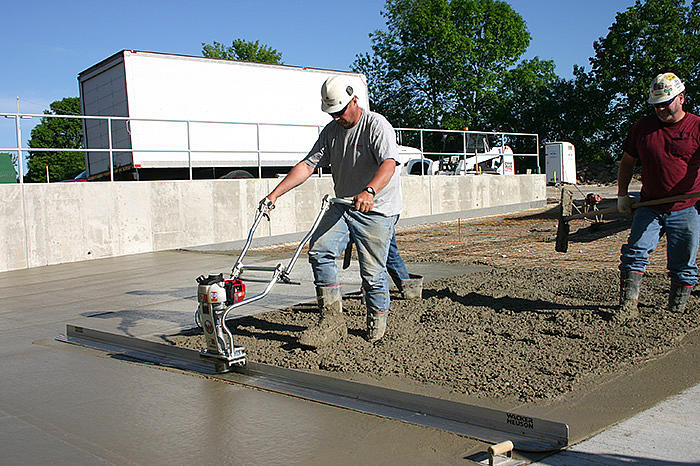
A vibrating screed vs truss screed vs roller screed comparison should start with the concrete slab rather than the machine catalogue. All three machines strike off fresh concrete, but they apply force differently. A vibrating screed shakes a lightweight blade, a truss screed transfers vibration through a rigid modular frame, and a roller screed rotates a tube across rails or forms.
Those differences affect working width, consolidation, labour, setup time and the finished surface profile. A portable vibrating screed suits many residential and smaller commercial pours. A truss screed becomes useful when the span, concrete depth or required profile exceeds the practical range of a handheld blade. A roller screed can handle anything from shaped channels to wide paving work, depending on its configuration. Concrete does not pause while the crew debates, so the selection needs to be made before the truck arrives.
Vibrating Screed vs Truss Screed vs Roller Screed: Quick Answer
| Selection factor | Vibrating screed | Truss screed | Roller screed |
|---|---|---|---|
| Typical format | Portable power unit and lightweight blade | Modular steel or aluminium frame | Rotating tube or self-propelled paving system |
| Working range | Short to medium formed bays | Wide roads, bridge decks and industrial slabs | Slabs, slopes, channels and wide paving work |
| Consolidation | Model-dependent vibration through the blade | Controlled vibration across a rigid frame | Depends on whether the system includes vibration |
| Setup demand | Low | Higher due to sections, rails and winches | Varies from simple tubes to large modular systems |
| Main selection risk | Using a blade that is too long or difficult to control | Underestimating assembly, rail support and engine demand | Assuming every rotating tube also consolidates concrete |
How the Three Concrete Screed Types Work
Vibrating Screed
A vibrating screed, also called a power screed or vibratory screed, uses an engine, battery or electric motor to vibrate a blade. The operator pulls the blade over fresh concrete while excess material moves ahead of it. The vibration helps settle the upper layer, fill shallow low spots and produce a more uniform strike-off.
Portable does not necessarily mean tiny. The Allen HD8080 vibrating screed uses blade options from 1.21 to 4.88 metres. Its power unit weighs 13.6 kg, operates at 7,500 rpm and carries a published maximum consolidation depth of 15.24 cm. Blade weight rises from about 3 kg at 1.21 metres to 12 kg at 4.88 metres, so longer blades increase both coverage and handling effort. These figures are specific to the HD8080, but they show why working width, blade weight and concrete depth should be checked together.
A vibrating screed is therefore a practical starting point for driveways, paths, house slabs and smaller commercial bays. However, a longer blade demands better coordination and stable forms. Adding length without considering blade stiffness is a little like using a longer ruler and expecting it never to bend.
Truss Screed
A truss screed joins several frame sections to create a rigid working span. An eccentric shaft, air-powered piston or similar vibration system distributes energy through the frame, while manual or hydraulic winches pull the machine along prepared rails. The rigid structure helps maintain the required grade, crown or crossfall over distances that would be difficult for a lightweight blade.
The Allen SE12 truss screed is rated for widths up to 19.8 metres, 10,000 vibrations per minute, a lowest recommended slump of 7.6 cm and a maximum consolidation depth of 25.4 cm. Allen specifies a 6.7 kW engine below 12.95 metres and an 8.2 kW engine above that width, showing that extra span also changes the power requirement. Husqvarna provides another official benchmark: its BT 90 modular system is listed for surfaces up to 25 metres wide and concrete depths up to 200 mm.
The extra capacity brings extra planning. A 3.04-metre SE12 steel section weighs approximately 82 kg. Long assemblies require organised transport, accurate section alignment, suitable rails and careful cleaning. Concrete left in a frame joint becomes surprisingly loyal once it hardens.
Roller Screed
A roller screed uses a rotating tube to push excess concrete forward while leaving the surface at the grade established by the forms or rails. Small roller screeds can work on driveways, ramps, channels and sloped slabs. Custom tubes can also follow gutters, drainage profiles and other shapes that are difficult to produce with a straight vibrating blade.
The category also includes much larger machines. Multiquip’s WRS5200 ride-on roller screed can be configured from 4.26 to 15.84 metres and has a published strike-off capacity of up to 10,000 square feet, approximately 929 m², per hour. The stated crew arrangement is one operator, two labourers and two concrete placers. This example shows that roller screeds are not limited to small shaped pours; some systems are built for high-output paving.
A rotating tube should not automatically be treated as a replacement for concrete vibration. Some roller systems mainly strike off and shape the surface, while others include separate consolidation equipment. Buyers should confirm the actual machine configuration and the project specification, particularly around reinforcement, deep sections and congested edges.
Width, Slump and Consolidation Must Be Considered Together
Slab width is only the first selection filter. The concrete slump, placement depth, reinforcement density and required finish also affect the result. A portable vibrating screed may cover a 4-metre bay, but that does not mean every 4-metre blade will remain easy to control on every mix. Likewise, a 20-metre truss screed still needs the correct engine, rail system and concrete consistency.
The SE12’s lowest recommended slump of 7.6 cm provides a useful example. Stiffer concrete requires more effort to move and consolidate, while highly fluid concrete can segregate if it receives excessive vibration. A published consolidation depth is also a machine-specific capability, not a guarantee that the entire slab will reach the specified density. Deep concrete, reinforcement zones and edges may still require internal vibrators.
Rail Support Can Decide the Finished Profile
Even a powerful concrete screed cannot produce a level slab while travelling on poorly supported rails. Multiquip recommends adjustable supports at approximately 0.91-metre intervals for one WRS5200 steel-tube rail arrangement. In that configuration, the stated rail deflection is about 1.6 mm. The exact support design must follow local engineering requirements, but the principle is clear: the screed follows the rail, including its mistakes.
Before the pour, contractors should inspect rail height, joints, support spacing and the stability of the subgrade or deck. A dry run is useful on large systems because it exposes weak supports and alignment errors while there is still time to fix them. Once the concrete arrives, every adjustment becomes more urgent and considerably less tidy.
Labour, Setup and Transport
A portable vibrating screed usually requires the least assembly and can often be repositioned by a small crew. A truss screed needs section assembly, bolts, winches, rail preparation and alignment. A roller screed may be simple when it uses a straight handheld tube, but large ride-on systems require dedicated transport, rail installation and a coordinated placing crew.
| Published equipment example | Verified figures | Planning lesson |
|---|---|---|
| Allen HD8080 vibrating screed | 13.6 kg power unit; blades from 1.21–4.88 m | Portable equipment still becomes heavier as blade length increases |
| Allen SE12 truss screed | Up to 19.8 m; 3.04 m steel section weighs 82 kg | Long spans require planned lifting, assembly and transport |
| Husqvarna BT 90 | Up to 25 m working width and 200 mm concrete depth | Large modular systems suit wide infrastructure pours |
| Multiquip WRS5200 | 4.26–15.84 m; up to approximately 929 m²/h | Roller systems can also serve high-output paving projects |
Source note: The figures above are published specifications for individual machines, not universal industry averages.
Which Concrete Screed Fits Each Project?
| Project | Recommended starting point | Reason |
|---|---|---|
| Residential driveway or path | Vibrating screed | Quick setup and manageable blade lengths |
| Warehouse or industrial slab | Truss screed | Rigid grade control across wider formed bays |
| Bridge deck or roadway | Truss or large roller screed | Long working spans and rail-controlled profiles |
| Ramp or sloped slab | Roller screed | Rotating tube can follow the formed slope |
| Drainage channel or gutter | Custom roller screed | Tube profile can match the required shape |
| Small slab with frequent relocation | Portable vibrating screed | Lower transport and assembly demand |
Final Concrete Screed Selection Checklist
Before choosing between the three concrete screed types, confirm the slab width, concrete depth, slump, reinforcement layout, required crown or crossfall, rail arrangement, available crew and transport limits. Then establish whether the machine must provide vibration, mainly strike off the surface or create a special profile.
Choose a vibrating screed when portability and fast setup suit the pour. Move to a truss screed when long spans, rigid grade control and stronger consolidation capacity justify the extra assembly. Consider a roller screed when the surface is sloped, shaped or wide enough to benefit from a powered roller system. The machine name creates the shortlist; the slab conditions make the decision.
Frequently Asked Questions
Is a power screed the same as a vibrating screed?
In most equipment searches, a power screed means a petrol, electric or battery-powered vibrating screed with a portable blade.
Does a roller screed consolidate concrete?
Not necessarily. A rotating tube mainly strikes off and shapes concrete unless the selected system includes a separate vibration mechanism. Internal vibration may still be required around reinforcement and deep sections.
How wide can a truss screed work?
Published modular systems vary by model. Allen lists the SE12 at up to 19.8 metres, while Husqvarna lists the BT 90 at up to 25 metres. Engine power, frame configuration and manufacturer limits must be checked for the selected width.
Which screed is easiest to transport?
A portable vibrating screed is usually the simplest to move because the power unit and blade can be separated. Truss and large roller systems require more space, lifting planning and assembly time.

