Can You Install Underfloor Heating on Concrete?
Yes, you can install underfloor heating on concrete, and in many projects, concrete is actually one of the best bases for a warm, stable, and comfortable floor. Concrete is strong, flat, durable, and able to store heat. That sounds like a perfect partner for underfloor heating, right? Well, almost. The real question is not only whether it can be done, but how it should be done correctly.
A new concrete slab, an old concrete floor, a bathroom renovation, and a large commercial heating project all need different installation methods. Some floors are suitable for electric heating mats. Some floors are better for wet underfloor heating pipes. Some existing concrete floors may need a professional floor heating milling machine to cut pipe grooves without raising the floor level too much.
Why Underfloor Heating Concrete Floor Systems Work So Well
An underfloor heating concrete floor system works well because concrete has thermal mass. In simple words, concrete can absorb heat and release it slowly. This helps the room stay warm in a more stable way. Instead of creating one hot corner near a radiator and one cold corner near the window, underfloor heating spreads warmth across the whole floor area.
This is why many engineers like concrete floor underfloor heating systems. The floor becomes a large low-temperature heat emitter. It does not need to feel extremely hot to make the room comfortable. Heat rises gently from the floor, which is exactly where people usually feel cold first. After all, nobody walks into a room and complains that their ceiling feels cold. Cold feet are the real troublemakers.
However, concrete can also absorb heat in the wrong direction if the installation is poorly designed. If there is no proper insulation under the heating system, part of the heat may move downward into the slab or ground instead of upward into the room. That means the heating system works harder, the floor warms up more slowly, and the customer may start wondering why their new underfloor heating behaves like a sleepy turtle.
Concrete Floor Underfloor Heating: New Build or Existing Floor?
A concrete floor underfloor heating project is easiest when it is planned during new construction. In a new build, the insulation layer, heating pipes, screed thickness, and final flooring can all be designed together. The installer has better control over pipe spacing, heating zones, floor level, and heat output.
Existing concrete floors are more challenging, but they are still very suitable when inspected properly. Before installation, the contractor should check whether the concrete is dry, level, strong, and free from serious cracks. If the floor is damp, dusty, weak, or uneven, those problems should be fixed first. Underfloor heating is a comfort system, not a magic doctor for a sick concrete floor.
For existing floors, the biggest issue is often floor height. Adding heating layers above the concrete can affect doors, skirting boards, kitchen cabinets, stairs, and room transitions. This is why retrofit methods are so important. In many renovation projects, cutting grooves into the existing floor can be more practical than building a thick new layer on top.
Electric Underfloor Heating on Concrete Floor
Electric underfloor heating on concrete floor is often used in bathrooms, kitchens, bedrooms, small offices, and renovation projects. It normally uses heating mats or loose heating cables installed over the prepared concrete surface. After that, the system is covered with tile adhesive, self-leveling compound, or another suitable layer before the final floor covering is installed.
The main advantage of electric underfloor heating is simplicity. It does not need water pipes, a manifold, a pump, or a boiler connection. For a small room, this can make installation faster and cleaner. Using a full wet system for a tiny bathroom may feel like using a crane to lift a sandwich. It works, but it may not be the smartest choice.
Electric systems also respond relatively quickly when they are installed close to the floor finish. This is useful for rooms that are not heated all day. For example, a bathroom may only need warm floors in the morning and evening. A fast-response electric system can be practical in this type of space.
However, electric systems are not always the best option for large spaces. Running cost depends on local electricity prices, heating demand, room insulation, and usage time. For large rooms, open-plan houses, or commercial floors, a wet system may be more economical in the long term.
Wet Underfloor Heating on Concrete Floor
Wet underfloor heating on concrete floor uses warm water pipes to distribute heat through the floor. The pipes are connected to a manifold, which controls water flow to different heating loops. This type of system is common in new homes, extensions, large rooms, workshops, showrooms, and commercial buildings.
The biggest advantage of wet underfloor heating is long-term efficiency across larger areas. Because the system heats the whole floor surface, it can often work at lower water temperatures than traditional radiators. This makes it suitable for modern boilers and heat pumps.
In a new concrete floor, the pipes can be installed before screed or concrete is poured. In an existing concrete floor, the pipes can be installed using low-profile overlay panels or by cutting grooves into the existing concrete or screed. When floor height is limited, the grooving method can be a very useful solution.
A wet system needs careful design. The installer must consider pipe diameter, pipe spacing, water temperature, flow rate, insulation, manifold position, and pressure testing. If the pipe layout is poorly planned, one side of the room may feel warm while the other side still feels like it is waiting for spring.
Best Retrofit Method for Existing Concrete Floors
For an existing concrete floor, the best retrofit method depends on floor condition, available height, project budget, and heating demand. If the floor height is not a problem, a low-profile overlay system can be simple and effective. If the room is small, electric heating may be the easiest solution. But if the project needs wet underfloor heating with minimal height increase, floor milling or grooving is often the better choice.
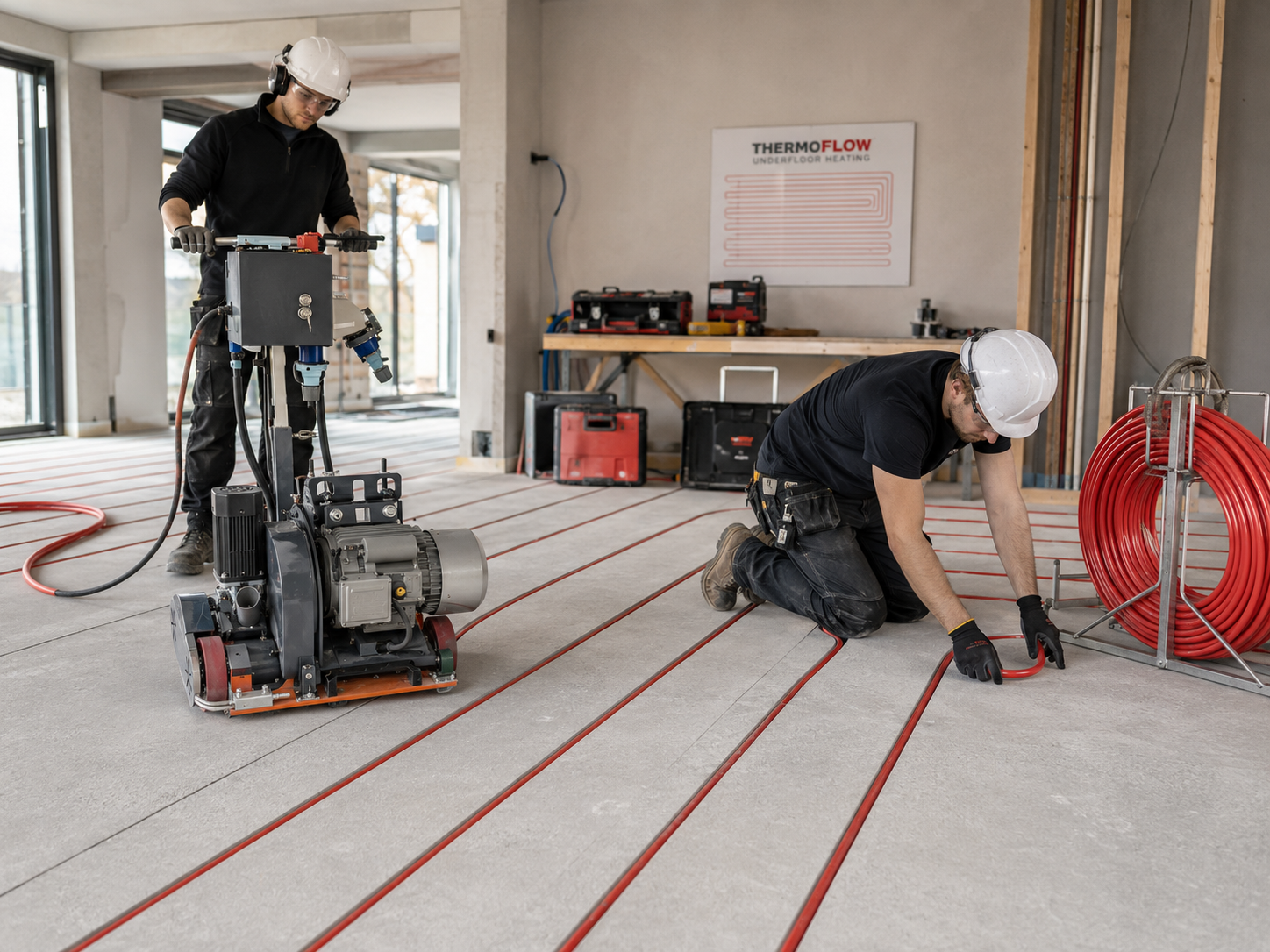
A floor heating milling machine cuts accurate grooves into the concrete or screed. Heating pipes are then placed inside the grooves, so the system does not need a thick build-up above the existing floor. This method is especially useful for renovation projects where doors, thresholds, cabinets, and stairs cannot easily be adjusted.
For professional contractors, a machine such as the GESP400V self-propelled underfloor heating grooving machine can help improve cutting efficiency and groove consistency. Compared with manual cutting, a dedicated grooving machine makes the pipe layout easier to control and the installation process more repeatable.
For smaller or push-type applications, the GE230V/GE400V floor heating milling machine is also a useful internal reference because it is designed for floor heating groove preparation. These types of machines are not just cutting tools. They help turn a complicated retrofit job into a controlled installation process.
What Is a Milling Machine Used For?
What is a milling machine used for? In underfloor heating projects, a milling machine is used to cut grooves or slots into an existing concrete floor or screed. These grooves create space for heating pipes, allowing the pipes to sit inside the floor instead of being placed above it.
This is important because many renovation projects cannot accept extra floor height. If the floor is raised too much, doors may need trimming, furniture may no longer fit correctly, and transitions between rooms may become awkward. A warm floor is wonderful, but a door that cannot close is not a good trade.
A professional industrial self-propelled electric floor heating milling machine can help contractors cut consistent channels with controlled depth and spacing. This is important for pipe stability, heat distribution, and final floor quality.
For engineers, the value of milling is not only speed. It is accuracy. Good groove quality helps the pipe sit correctly, reduces unnecessary floor build-up, and makes the whole heating layout easier to inspect before covering.
Do You Need Insulation Under Underfloor Heating on Concrete?
Yes, insulation is strongly recommended for most underfloor heating on concrete projects. Without insulation, heat can move downward into the concrete slab or ground instead of upward into the room. The system may still work, but it will take longer to warm up and may use more energy.
Insulation is like traffic control for heat. It tells the heat where to go. Without it, heat will make its own travel plan, and unfortunately, that plan may include warming the ground under the building. That is not the kind of luxury most customers want to pay for.
For ground floors and older buildings, insulation becomes even more important. Many old concrete floors were not designed for modern radiant heating systems. If full insulation is difficult in a renovation project, the installer should still consider low-profile insulation boards or other thermal layers that reduce heat loss without creating too much floor height.
Surface Preparation Before Installing Underfloor Heating
Before installing any underfloor heating system, the concrete surface must be prepared correctly. The floor should be clean, dry, stable, and level. Loose dust, oil, weak screed, paint, and old adhesive residues should be removed. If the surface is rough or uneven, the heating system may not sit correctly, and the final floor finish may suffer.
In some projects, floor grinding is needed before heating installation. This helps remove surface contamination and improve the flatness of the floor. Contractors can refer to the floor grinding machine category when the project requires surface preparation before grooving, leveling, or floor finishing.
For smaller renovation projects, a machine such as the 6T-540 concrete floor grinding machine can be relevant when the floor needs cleaning, leveling, or surface correction before the underfloor heating system is installed.
Dust Control During Floor Heating Grooving
Cutting or milling concrete can produce a lot of dust. In indoor renovation projects, dust control is not a small detail. It affects worker comfort, jobsite cleanliness, customer satisfaction, and sometimes even the schedule. A perfect groove pattern is less impressive if the whole room looks like a flour factory exploded.
This is why a professional dust extraction system should be considered when grooving concrete floors. Using an industrial vacuum cleaner together with a floor heating milling machine can help keep the work area cleaner and reduce airborne dust during cutting.
For related equipment, contractors can check the ACE 65kg industrial dust removal system, which is suitable as a supporting product for dust-heavy floor renovation and grooving work.
What Flooring Is Not Suitable for Underfloor Heating?
What flooring is not suitable for underfloor heating? Generally, floor coverings that block heat, move too much with temperature changes, or cannot tolerate stable warmth are not ideal. Very thick carpet, heavy underlay, some solid wood floors, and low-quality vinyl or laminate products can cause problems if they are not approved for heated floors.
This does not mean these materials can never be used. It means the flooring manufacturer’s guidance must be checked carefully. The installer should confirm the maximum surface temperature, thermal resistance, adhesive compatibility, and expansion behavior.
Hard floor finishes usually work better with underfloor heating. Ceramic tile, porcelain tile, natural stone, polished concrete, and some engineered wood products can transfer heat more efficiently. If the final flooring acts like a thick winter coat, the heat will struggle to pass through. The heating system may be working perfectly, but the room may still feel cold.
Can You Use Travertine with Underfloor Heating?
Can you use travertine with underfloor heating? Yes, travertine can usually be used with underfloor heating because it is a natural stone material that conducts and stores heat well. This makes it suitable for warm, comfortable floors in bathrooms, kitchens, living rooms, and other areas where stone flooring is preferred.
However, travertine must be installed correctly. The concrete base should be dry, level, and stable. The adhesive must be suitable for heated floors, and movement joints should be planned where needed. Natural stone looks strong, but it still dislikes poor installation. It is elegant, not invincible.
After installation, the heating system should be commissioned gradually. The temperature should be increased slowly, not turned to full power immediately. Sudden heating can create stress in the floor build-up, especially before adhesive or leveling compound has fully cured.
How Long Do Underfloor Heating Manifolds Last?
How long do underfloor heating manifolds last? A good-quality manifold can last many years, but its actual service life depends on installation quality, water quality, pressure conditions, material quality, and maintenance. In a wet underfloor heating system, the manifold is the control center. It distributes warm water to different heating loops and helps balance the system.
The pipes inside the floor are usually designed for long-term use. The manifold, however, contains parts that may need inspection or replacement over time. These include flow meters, valves, actuators, seals, and connection points.
This is why the manifold should always remain accessible. It should not be hidden behind permanent walls or placed somewhere impossible to reach. If a heating loop needs balancing or repair later, the installer will need access to the manifold. A hidden manifold may look neat on day one, but it can become a headache on day one thousand.
Common Mistakes When Installing Underfloor Heating on Concrete
The first common mistake is ignoring the concrete condition. If the floor is dusty, cracked, damp, or uneven, the heating system may not perform properly. The concrete should be repaired and prepared before installation.
The second mistake is choosing the wrong heating type. Electric underfloor heating on concrete floor can be excellent for small rooms, but it may not be economical for large areas. Wet underfloor heating on concrete floor can be efficient for bigger projects, but it requires more planning, more installation work, and proper manifold control.
The third mistake is forgetting about insulation. Concrete can store heat, but it can also steal heat if the system is not designed correctly. A cold slab under the heating system can slow down heat-up time and increase energy use.
The fourth mistake is not considering floor height. Overlay systems are convenient, but they add height. Milling or grooving may be better when the existing concrete floor must stay close to its original level.
The fifth mistake is skipping testing. Electric cables should be tested before and after covering. Wet systems should be pressure tested before the final floor finish is installed. Testing may feel boring, but repairing a finished floor is much more boring and much more expensive.
Best Method for Installing Underfloor Heating on Concrete
The best method depends on the project. For a small bathroom or kitchen renovation, electric underfloor heating may be the most practical choice. It is simple, fast, and suitable for tiled floors. For a new build or large open area, wet underfloor heating may be better because it can provide efficient whole-room heating and work well with modern heat sources.
For an existing concrete floor where floor height is limited, a grooved or milled wet underfloor heating system can be a strong solution. It allows pipes to be installed into the existing floor structure instead of adding a thick new layer above it.
For professional installers, using a suitable floor heating milling machine can improve accuracy, reduce manual labor, and make the installation process more repeatable. For customers, it can make the renovation cleaner, faster, and less disruptive.
Conclusion
So, can you install underfloor heating on concrete? Yes, absolutely. Concrete can be a strong and reliable base for underfloor heating, as long as the system is designed correctly. The important part is choosing the right method for the project.
Electric underfloor heating is simple and useful for smaller rooms. Wet underfloor heating is efficient for larger spaces and long-term comfort. For existing concrete floors, a milled groove system can be a smart retrofit solution because it reduces floor height increase and allows heating pipes to be installed neatly into the floor.
A successful project is not only about placing pipes or cables under the floor. It is about understanding the full floor system: concrete condition, insulation, heating type, pipe layout, manifold access, flooring material, dust control, and commissioning process.
When all these details work together, underfloor heating on concrete can deliver stable warmth, better comfort, and a cleaner room design. In other words, the floor does more than hold your furniture. It quietly becomes the warmest team member in the building.

