Product knowledge popularization
A construction equipment supplier of construction machinery solutions for 30 years. WhatsApp:+86-18968212829
Language
A construction equipment supplier of construction machinery solutions for 30 years. WhatsApp:+86-18968212829
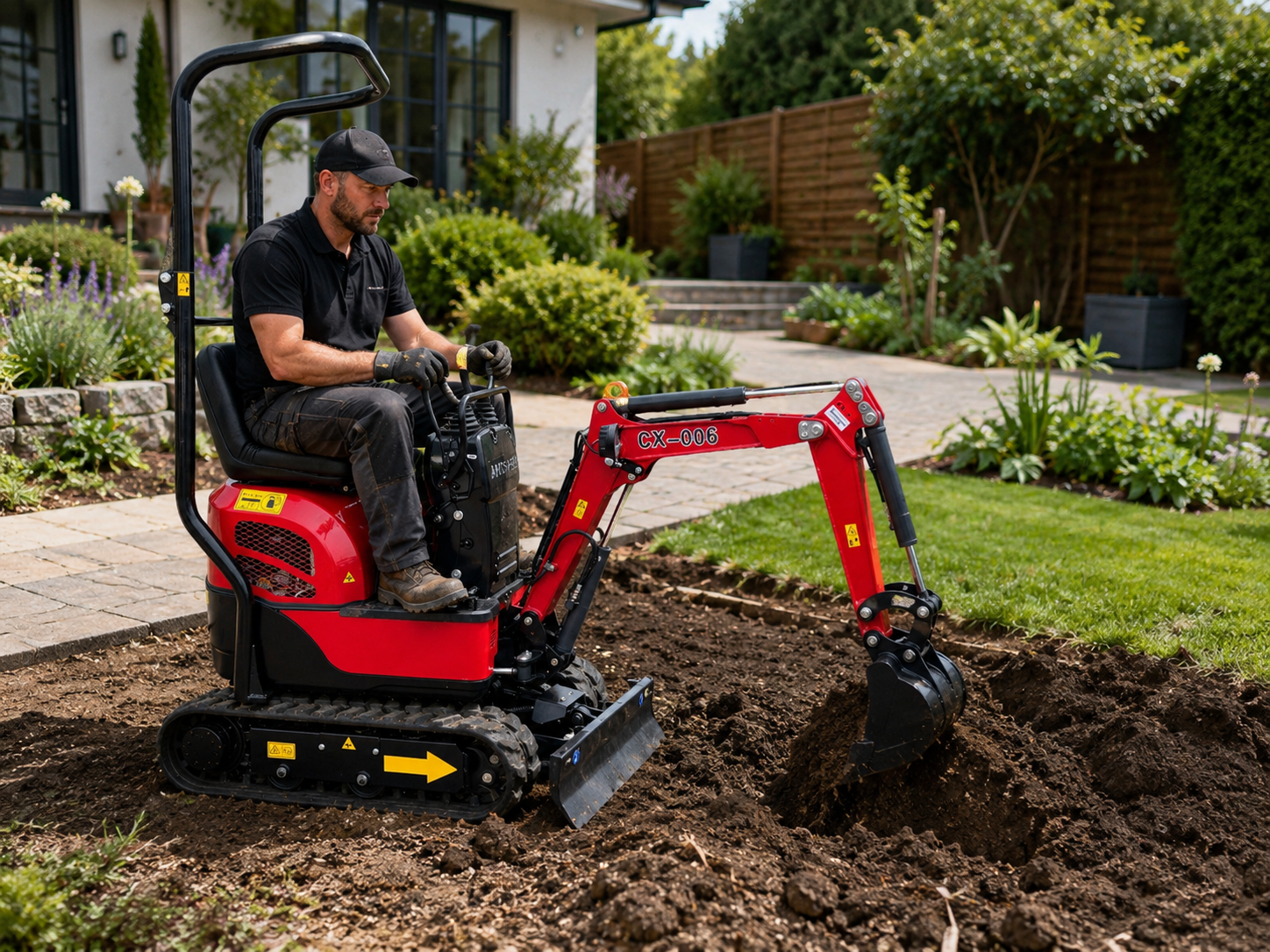
A narrow access mini excavator can save a contractor from one of the most annoying problems on a small job site: the machine is powerful enough, the operator is ready, the customer is watching, and then the excavator cannot pass through the gate. At that moment, even the strongest engine cannot argue with a brick wall.
For landscaping, garden renovation, drainage trenches, small foundations and residential repair work, size is not a small detail. It is often the first buying decision. A micro excavator must enter the site, move safely, dig with enough force and leave without turning the customer’s lawn into a battlefield. That is why many contractors, rental companies and dealers are paying closer attention to compact machines under 700 mm wide.
This guide explains how to choose a narrow access mini excavator in a practical way. We will look at width, operating weight, boom swing, engine options, hydraulic performance, transport, attachments and common buying mistakes. The goal is simple: help buyers choose a machine that fits the work, not just the brochure.
A narrow access mini excavator is a compact crawler excavator built for sites where larger machines cannot move easily. It is often called a micro excavator, micro digger, compact mini excavator or small excavator for tight spaces. The name may change from market to market, but the buying logic is the same: the machine must pass through narrow entrances and still perform useful digging work once it arrives.
These machines are commonly used for garden landscaping, house renovation, orchard work, utility trenches, drainage ditches, small retaining walls, pool preparation and light demolition support. They are also useful for rental fleets because one small machine can serve many different customers. A builder may need it for footings on Monday, a landscaper may need it for a garden path on Wednesday, and a farmer may need it for a small drainage job at the weekend.
For international B2B buyers, the narrow access category is attractive because it solves a very real job-site problem. Many residential sites in Europe, the UK, Australia and North America have limited access. A full-size excavator may offer more digging power, but if it cannot enter the working area, it becomes a very expensive decoration outside the gate.
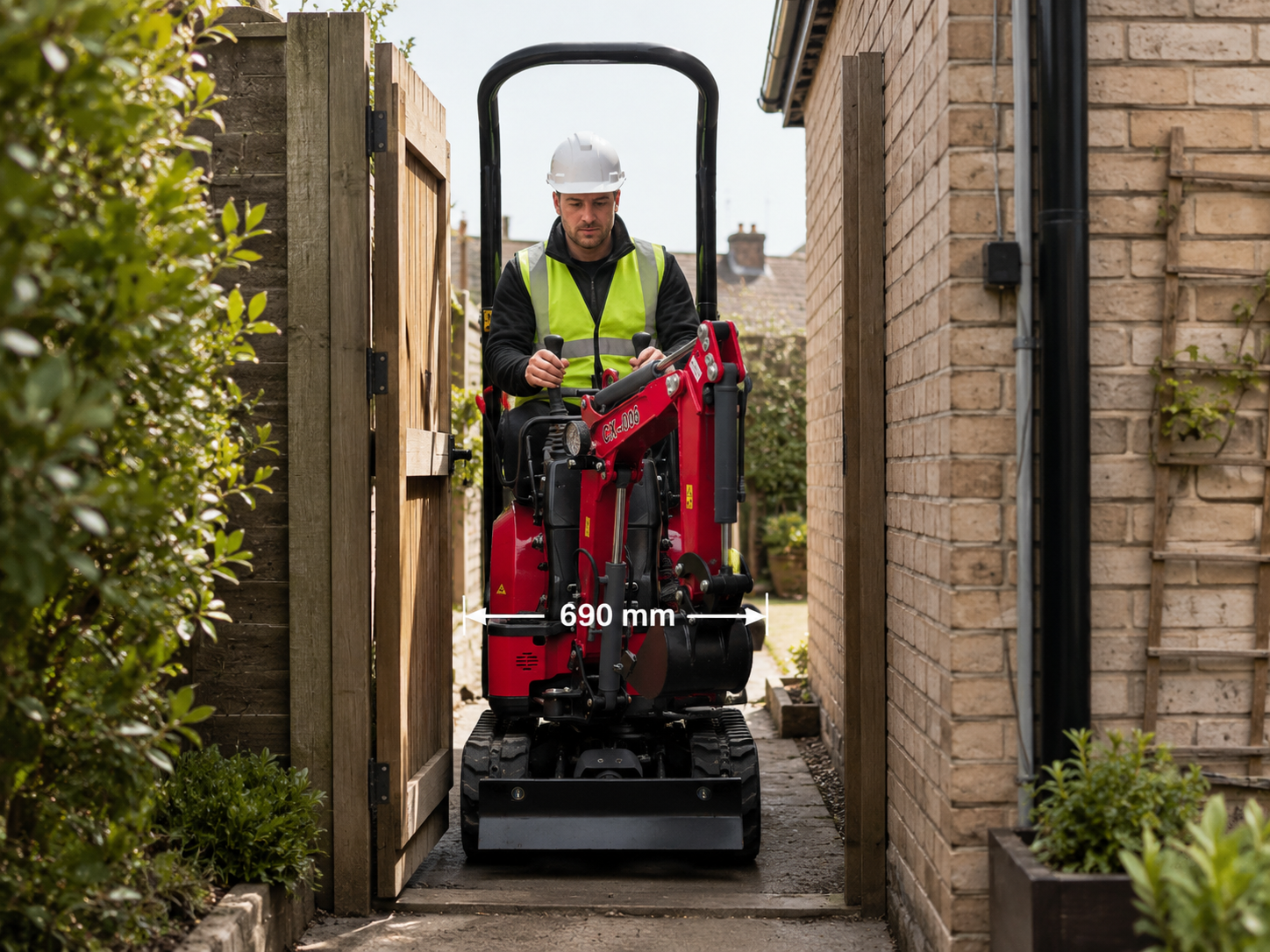
When choosing a mini excavator for landscaping or renovation, many buyers first ask about engine power or digging depth. Those are useful numbers, but the first question should often be: how wide is the machine?
For narrow residential jobs, machine width controls whether the excavator can pass through side gates, garden entrances, small alleys, greenhouse paths and tight access routes between buildings. A few centimetres can decide whether the operator starts digging or starts making phone calls to apologise.
The CX-006 from ACE Machinery is a good example of this narrow access thinking. Its machine width is only 690 mm, allowing it to pass through openings of around 700 mm. That makes it suitable for garden entrances, renovation sites and small residential spaces where a wider machine would struggle. The machine also has a reduced rear swing radius of 735 mm and a reduced rear overhang of 240 mm, helping the operator work closer to walls and boundaries.
Width is also connected to site safety. When a machine works in a narrow passage, the operator has less room for correction. A compact body reduces the risk of scraping walls, fences, door frames and finished surfaces. For rental companies, that can also reduce customer complaints. Scratched garden walls do not help repeat business.
A micro excavator is not trying to replace a larger excavator on heavy civil engineering projects. It earns its place by working where larger machines are too wide, too heavy or too awkward to use.
For landscapers, a mini excavator for landscaping can handle soil removal, planting pits, path preparation, small pond digging, retaining wall footings and ground levelling. In garden renovation, access is often the hardest part of the job. A narrow access mini excavator can pass through a tight entrance, dig efficiently and reduce the amount of manual labour needed.
Anyone who has moved wet soil by wheelbarrow for a full day knows that a small excavator is not a luxury. It is a back-saving machine with tracks.
Small drainage trenches often run close to walls, fences, driveways and existing structures. This is where compact dimensions and boom swing become very useful. A machine such as the CX-006, with 65° left and 70° right boom swing, can dig along edges without constantly repositioning the whole body.
For contractors installing drainage pipes, electrical ducts, irrigation lines or small utility trenches, this can improve speed and accuracy. It also reduces ground disturbance because the tracks do not need to move as often.
House renovation projects often include old foundations, drainage repairs, small extensions, floor preparation and garden reshaping. The job site may already have fences, walls, trees, paving and finished surfaces. A compact mini excavator gives the contractor more control in these sensitive spaces.
In renovation work, the machine must be strong enough to dig but gentle enough not to damage everything around it. That balance is exactly where a micro digger becomes useful.
Small farms and orchards often need trenching, irrigation repair, post-hole preparation and light earthmoving. In greenhouses or between crop rows, a standard machine can be too wide. A narrow access mini excavator can work in restricted spaces while keeping ground pressure relatively low compared with heavier machines.
A good buying decision should not depend on one number. A mini excavator is a complete system: weight, engine, hydraulics, digging force, swing structure, tracks, blade, transport size and attachments all work together. When one part does not match the job, the whole machine feels wrong.
Width is the first narrow access specification. For the CX-006, the transport dimensions are 2150 × 690 × 2080 mm. This compact size makes the machine easier to move on a small trailer or utility vehicle, depending on local transport rules and trailer capacity.
Dealers and rental companies should always show customers the actual transport dimensions, not only the working weight. Many buyers can imagine a machine’s digging depth, but they may forget to check whether it fits through the gate, into the trailer or under a low entrance.
Operating weight affects stability, transport and digging feel. The CX-006 has an operating weight above 790 kg and a transport weight above 715 kg, depending on configuration. This places it in the micro excavator range where buyers often compare 600kg-class, 0.8 ton and 1 ton machines.
A lighter machine is easier to transport and better for sensitive ground. A heavier machine may feel more stable and may offer stronger digging performance. The right choice depends on the job. For narrow access landscaping, too much weight can be a problem. For tougher digging, too little weight can also be a problem. Buyers should avoid choosing by weight alone.
Digging force tells you how well the machine can break soil, pull material and load the bucket. The CX-006 has digging force figures of 390 kgf for the arm and 690 kgf for the bucket. Its hydraulic system includes a 7.8 L system capacity, 170 bar maximum pressure and two gear pumps rated at 2 × 6.92 L/min.
For engineers and procurement teams, these numbers matter because they show the relationship between size and performance. A narrow access machine should still have enough hydraulic power for practical digging. Otherwise, the operator spends the day politely scratching the ground instead of excavating it.
Ground clearance affects how the machine moves over uneven soil, small stones and site debris. The CX-006 has 155 mm ground clearance, 180 mm shoe width and ground pressure of around 0.27 kg/cm². These figures help buyers judge how the machine may behave on lawns, soft soil and garden surfaces.
Rubber tracks are generally preferred for residential and landscaping work because they reduce surface damage compared with steel tracks. They also make the machine more suitable for paved areas, finished driveways and garden paths.
Boom swing is one of the most useful features on a narrow access mini excavator. It allows the boom to move left and right without turning the whole machine body. On paper, that sounds like a small movement. On site, it can save a lot of repositioning.
The CX-006 offers boom swing of 65° left and 70° right. This is useful when digging drainage ditches along walls, working beside fences, trenching near buildings or clearing soil in corners. Instead of moving the tracks every few minutes, the operator can adjust the boom position and keep digging with better control.
For narrow residential sites, less repositioning means less ground damage, fewer track marks and faster work. It also helps newer operators because they can place the bucket more accurately in tight areas. That does not mean skill is no longer needed. The machine helps, but it will not magically turn a careless operator into a surgeon. It is still an excavator, not a violin.
Engine choice should match the buyer’s market, fuel preference, service ability and emissions requirements. The CX-006 can be configured with different engine options, including a Loncin gasoline engine, a Briggs & Stratton gasoline engine and a Kubota diesel engine option.
Gasoline engines are often simple to use and familiar to many landscaping users. They can be convenient for small contractors who already use petrol-powered compact equipment. Diesel engines are often preferred in construction fleets because diesel fuel is common on job sites and diesel engines are widely accepted for equipment use.
For dealers, the right engine option depends on the local customer base. A rental company may care about easy starting, service parts and simple operation. A contractor may care more about fuel availability, reliability and long working hours. An importer may need to check local emissions rules before choosing the engine configuration.
A micro excavator becomes more valuable when it can use the right attachments. The CX-006 can be supplied with a standard bucket, ditch cleaning bucket and swivelling bucket, with special paint also available as an option.
The standard bucket handles everyday digging, loading and trenching. A ditch cleaning bucket is useful for drainage work, shallow cleaning, grading and removing loose material. A swivelling bucket helps when shaping slopes, working at angles or cleaning awkward sections where a fixed bucket would need more machine movement.
For rental companies, attachments can improve machine utilisation. The same narrow access mini excavator can serve landscapers, drainage contractors, builders and maintenance teams. For dealers, attachment packages can also make the machine easier to sell because buyers see more uses from one compact unit.
The first common mistake is buying only by price. A cheap machine that cannot pass through the customer’s gate, lacks service support or has poor hydraulic control may cost more in the long run. Low purchase price is nice. Low working value is not.
The second mistake is ignoring actual site access. Buyers should measure gate width, alley width, turning space, ground condition and transport route before ordering. A narrow access mini excavator is chosen because access is difficult, so the access details deserve proper attention.
The third mistake is choosing too much machine. Bigger is not always better in residential work. A larger excavator may dig faster in open space, but it can be slower and riskier in a small garden. The operator may spend more time turning, repositioning and avoiding damage than digging.
The fourth mistake is forgetting after-sales support. Dealers and rental companies should check spare parts availability, wearing parts, engine service, hydraulic hose access, bucket pins, tracks and basic maintenance points. A compact machine should be easy to service, because small machines often work for many different users in many different conditions.
The fifth mistake is ignoring operator comfort and safety. A clear operating position, protective frame, simple control layout and stable working stance all matter. The CX-006 includes a standard ROPS protective frame and an ergonomic operating position, which are useful points for rental and contractor use.
The ACE Machinery CX-006 fits this market because its strongest advantage is not one dramatic feature. It is the combination of compact size, narrow width, usable digging performance and practical configuration.
With a machine width of 690 mm, it can enter many tight spaces where standard compact excavators cannot go. Its short rear overhang and reduced rear swing radius help when working close to walls, fences and buildings. The boom swing function supports drainage and edge trenching. Its transport dimensions make it manageable for small contractors and rental teams that need easy movement between jobs.
The machine also gives buyers several engine options, useful hydraulic performance and practical attachments. For a contractor, this means one small excavator can handle many daily jobs. For a dealer, it means the machine can be positioned for landscapers, builders, rental users, garden contractors, small farms and property maintenance companies.
The CX-006 should not be presented as a heavy excavation machine. That would create the wrong expectation. Its real value is narrow access work, controlled digging and flexible use in small spaces. When the job is tight, light and detailed, a micro excavator can be the machine that gets through the gate and gets the work done.
For dealers, the strongest selling message is not simply “small excavator for sale”. That keyword is too broad and attracts many different buyers. A stronger message is narrow access mini excavator for landscaping, drainage and renovation work. This speaks directly to a job-site problem.
Rental companies can position the machine as a practical solution for garden access, small trenching, footings, drainage repairs and residential projects. Rental customers often search by task rather than model number. They may ask, “Can this fit through my garden gate?” or “Can it dig a drainage trench behind the house?” The sales page and blog content should answer those questions clearly.
For wholesalers and importers, the CX-006 can be placed in the 600kg-class or micro excavator category, while also explaining the actual operating weight and configuration. Clear specifications build trust. If buyers understand the width, weight, hydraulic performance and use cases before purchase, they are less likely to complain later.
Before ordering, buyers should check the narrowest site entrance, required digging depth, soil type, transport method, engine preference, attachment needs and spare parts support. The machine should match the real working environment, not only the catalogue image.
For landscaping, focus on width, rubber tracks, ground pressure, bucket options and ease of transport. For drainage work, check boom swing, digging force and bucket choices. For rental fleets, check simple operation, safety frame, service access and common wear parts. For dealers, check market demand, engine configuration and whether the machine can be explained clearly to first-time buyers.
A narrow access mini excavator is often bought because the job site gives no second chance. If the machine is too wide, the work stops before it starts. If the machine fits, digs and moves safely, it quickly becomes one of the most useful machines in a small equipment fleet.
Some micro excavators can fit through narrow garden gates, but buyers must check the exact machine width and the actual gate opening. The CX-006 has a width of 690 mm and can pass through openings of around 700 mm, making it suitable for many narrow residential access routes.
Many narrow access micro excavators are around 700 mm to 800 mm wide, although specifications vary by model and track configuration. For very tight access, a machine under 700 mm wide gives contractors more flexibility.
Yes, a micro excavator is very useful for landscaping tasks such as soil removal, trenching, garden reshaping, planting pits, path preparation and small retaining wall footings. It is especially useful where larger excavators cannot enter the site.
For backyard work, many contractors choose a micro excavator or 0.8 ton class mini excavator because it offers compact size, lower ground pressure and easier access. The right size depends on gate width, soil condition, digging depth and transport method.
Boom swing allows the operator to dig to the left or right without moving the whole machine body. This is useful near walls, fences, drainage lines and tight corners where constant repositioning would waste time and damage the ground.
Gasoline engines can be convenient for small contractors and landscaping users, while diesel engines are common in construction fleets. The better choice depends on local fuel availability, emissions rules, service support and customer preference.
A standard bucket is useful for general digging, while a ditch cleaning bucket helps with drainage and grading. A swivelling bucket can improve control when shaping slopes or working at awkward angles.

