A construction equipment supplier of construction machinery solutions for 30 years. WhatsApp:+86-18968212829
Language
A construction equipment supplier of construction machinery solutions for 30 years. WhatsApp:+86-18968212829
A plate compactor (often referred to as a vibratory plate compactor) is a subtype of compaction equipment. Both plate compactors and rammers are used to compact soil in foundation construction, but they differ in operation method, working depth, and ideal applications.
What is a plate compactor?
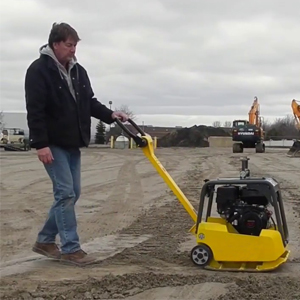
A plate compactor is a type of construction machinery used to compress and level soil, gravel, sand, or asphalt, creating a stable, uniform surface. It has a heavy, flat metal plate on its base that vibrates rapidly when powered by a gasoline or diesel engine. This vibration forces air pockets out of the material and compacts it tightly.
Plate compactors are commonly used in road construction, landscaping, and foundation preparation. They come in different types, such as forward-moving, reversible, and heavy-duty models, depending on the project size and soil type.
What is a rammer?
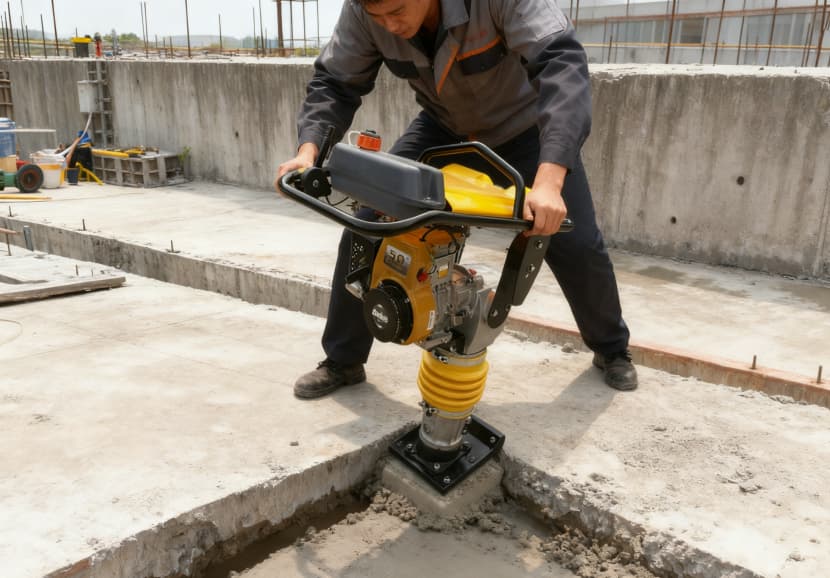
A rammer—also known as a tamping rammer or jumping jack—is a small compaction machine that uses high-frequency impact energy to compact soil, sand, or gravel. Instead of a vibrating plate, the rammer uses a vertical impact motion, combining shock and vibration to rearrange soil particles and increase density.
Because of its compact size, mobility, and focused impact force, the rammer is best for narrow areas, trench backfilling, corners, and road repairs. It performs especially well in cohesive soils like clay or silt, where vibration alone cannot achieve deep compaction.
Key Technical Differences
| Category | Plate compactor | Rammer |
| Compaction Principle | Vibratory compaction | Impact + vibration compaction |
| Best for Soil Type | Non-cohesive (sand, gravel, asphalt) | Cohesive (clay, silt) |
| Compaction Depth | Shallow (up to 30 cm) | Deep (up to 1–3 m)深 |
| Working Area | Wide, open, flat surfaces | Narrow, confined, or sloped areas |
| Mobility | Easy to move with wheels; quick site transfers | Requires lifting or cart transport; more effort to move |
Ease of Operation | Smooth, low recoil, suitable for beginners | Higher recoil; requires strength and control |
| Common Uses | Road bases, pavements, landscaping | Trenches, foundations, corners, road repairs |
Plate compactors are easy to operate.
Weight and mobility: The machine typically weighs 30-80 kg, making it easy for one person to carry or even move by hand. Some models are equipped with auxiliary wheels, eliminating the need to lift the machine during transfer, making them suitable for frequent site changes (such as switching between multiple rooms during interior renovations).
Operational principles: After starting, simply hold the handle with both hands to control the direction. The machine automatically moves forward using the centrifugal force generated by the rotating eccentric mass. The operator does not need to exert any additional force; only minor adjustments are required to achieve linear or circular compaction, making it easy for beginners to learn.
Environmental adaptability: The low profile and foldable handle allow it to pass through narrow passages such as doors and elevators. When operating in confined spaces such as indoor spaces and stairwells, the machine is easy to control and is less likely to collide with surrounding objects.
The control threshold for the impact rammer is slightly higher, requiring adaptation to the recoil force.
Weight and mobility: Pneumatic models are lighter, while gasoline models are heavier. While they can be carried by one person, they lack auxiliary wheels (which can be easily damaged by high-frequency impact). Long-distance transfers require hand-carrying or the use of a tool cart, which increases physical exertion during frequent site changes.
Operational Principle: After startup, the machine undergoes high-frequency impact operation, generating strong vertical recoil and lateral vibration. The operator must firmly grasp the handles with both hands to resist recoil while manually pushing the machine. Directional control requires coordinating the "thrust" and "recoil" forces, and novice operators may experience the machine bouncing or drifting.
Environmental Adaptability: Suitable for narrow but flat trenches and corners. If the ground slope exceeds 5°, the recoil force may cause the machine to "slide out of control," requiring the operator to apply additional force to stabilize the machine, reducing ease of use.
If you prioritize ease of use, comfort, and a smooth surface, especially on flat, open, and granular surfaces, choose a plate compactor. If you require deep, powerful compaction in narrow or vertical areas, especially on clay or cohesive soils, choose a tamping machine.
In modern construction, both machines are often used together for optimal results. Tamping machines provide deep, corner compaction to ensure a stable foundation. Plate compactors level the surface for a smooth, uniform finish. This combination ensures maximum compaction strength and surface uniformity, meeting the structural and aesthetic requirements of professional engineering projects.
There's a fundamental difference between the working principles of plate compactors and impact rammers: Plate compactors rely on high-frequency, low-amplitude vibrations to achieve gentle, uniform compaction. Impact rammers, on the other hand, deliver high impact energy for powerful, deep compaction.
In short, for comfort, simplicity, and speed, choose a plate compactor. For precision, deep work in tight spaces, choose a tamper.
Both are essential tools in the construction industry, working together to ensure that every layer of your project—from the deep foundation to the final surface—is perfectly compacted.

