A construction equipment supplier of construction machinery solutions for 30 years. WhatsApp:+86-18968212829
Language
A construction equipment supplier of construction machinery solutions for 30 years. WhatsApp:+86-18968212829
A concrete power trowel machine (commonly referred to as a power trowel) is a critical piece of equipment for finishing concrete surfaces, ensuring smoothness, density, and uniformity. The following is a detailed breakdown of its types, working principles, selection criteria, and advantages—with key terms like concrete power trowel, concrete power trowels, riding power trowel, handheld power trowel, and power trowel combo blades integrated throughout.
Types of Concrete Power Trowels
Concrete power trowels are mainly categorized by their operation mode, each tailored to specific project scales and requirements.
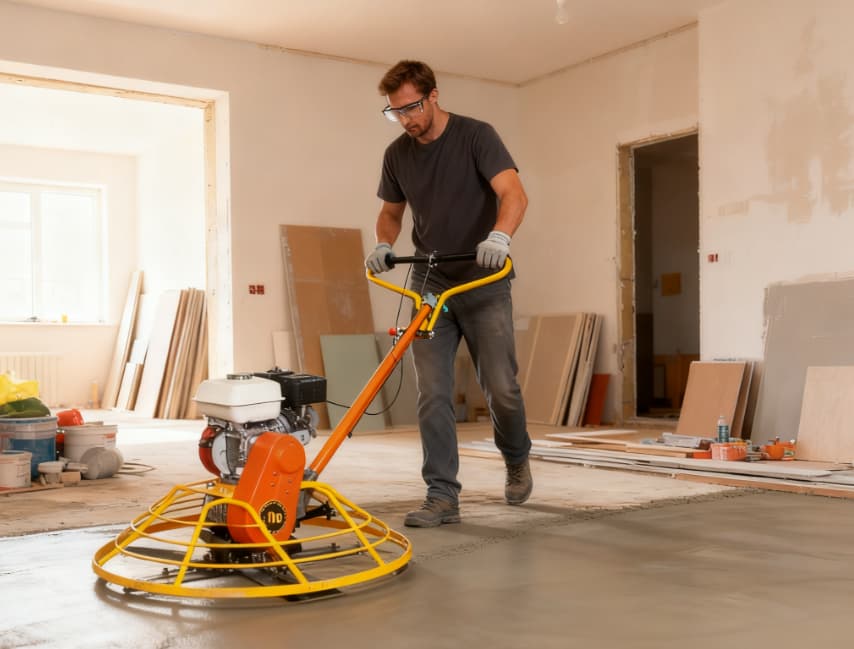
Handheld power trowel
Also known as walk-behind electric trowels, handheld power trowel is a compact type of concrete power trowel ideal for small to medium-sized jobs. It requires the operator to push the machine from behind, relying on manual control of speed. Its small disc coverage area excels at detail work (e.g., complex corners) and small-area applications, emphasizing flexibility and precision.
This type of concrete power trowel meets medium-level smoothness requirements at a lower cost, making it an economical choice for projects like residential patios or small commercial floors—where large-scale efficiency is less critical than maneuverability.
Riding power trowel
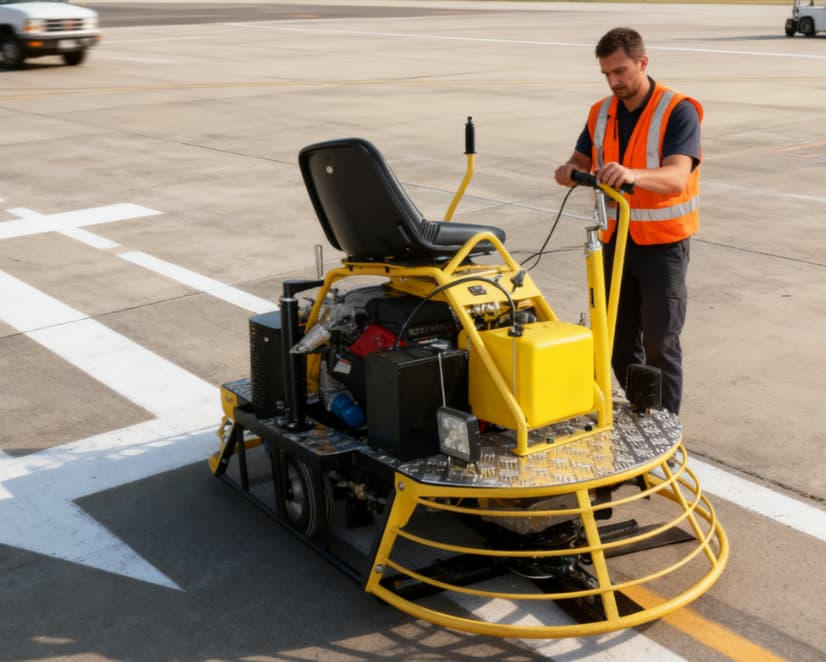
A riding power trowel (ride-on electric trowel) is a high-efficiency variant of concrete power trowels, designed for large-scale construction. Equipped with a high-powered motor, large-diameter discs, and a rideable platform, it enables continuous operation while significantly reducing operator fatigue.
Its core advantage lies in improved overall construction efficiency: the dual- or multi-disc design allows for large-scale coverage, enhancing the density and uniformity of concrete surfaces. Though the initial investment in a riding power trowel is higher, long-term construction costs are lower—making it ideal for standardized, large projects (e.g., warehouse floors, factory workshops) with high-standard flooring requirements.
Working Principle and Components of a Concrete Power Trowel Machine
Working Principle
The core of a concrete power trowel machine (or power trowel) is the rotation of its blades. As the blades—often power trowel combo blades for versatile performance—rotate, they smooth the concrete surface by leveling and compressing it. By adjusting two key factors—power trowel combo blades spacing and rotation speed—operators can control the surface finish, ranging from a rough texture (for non-slip needs) to a highly polished finish (for decorative floors).
Main Components
Blades (Pans)
The component that directly contacts the concrete surface. Among them, power trowel combo blades stand out for their optimized design: they combine the functions of leveling and polishing, adapting to different concrete consistencies and finish requirements, and are key to achieving professional-grade smoothness.
Engine
Provides power to drive the power trowel’s blades. Engine performance directly determines the machine’s ability to process different concrete mixes (e.g., high-density or low-slump concrete) and achieve the desired surface finish.
Handle/Controls
The interface for operators to control the concrete power trowel’s movement and operation. Handles can be precisely adjusted (e.g., height, angle) to fine-tune pressure on the blades, further controlling the concrete surface’s smoothness.
How to Choose the Right Concrete Power Trowel
Selecting a suitable concrete power trowel (a core part of any concrete power trowel machine) requires focusing on five key criteria, tailored to project scale, environment, and quality demands:
Blade Specifications: This includes blade diameter (affecting working area and processing efficiency) and blade type (e.g., whether to use power trowel combo blades). For small, detailed projects, smaller blades or power trowel combo blades with flexible adjustment are preferred; for large areas, larger blades (paired with riding power trowel) are more efficient.
Power Source: Concrete power trowels use three main power sources—gas, diesel, or electric. Choose based on the construction environment: electric models (common for handheld power trowel) are ideal for indoor or enclosed spaces (no exhaust), while gas/diesel models (often for riding power trowel) suit open-air, large-scale sites without power access.
Control System: A user-friendly, precise control system directly impacts operational ease and finish quality. For example, handheld power trowel needs sensitive speed controls for detail work, while riding power trowel requires stable steering to ensure uniform coverage.
Blade Pitch Range: This determines how much the power trowel combo blades (or standard blades) press into the concrete, affecting the range of finish adjustment. A wider pitch range allows switching between rough and polished finishes, increasing the machine’s versatility.
Safety Features: Ensuring operator safety is non-negotiable. Look for features like emergency stop buttons, anti-slip platforms (for riding power trowel), and insulated handles (for electric handheld power trowel) to minimize accident risks.
| Job Type | Recommended Model | Features |
| Small residential | Walk-behind, 24–36″ | Lightweight, easy to maneuver |
| Medium commercial | Walk-behind, 36–48″ | Variable pitch, stronger engine |
| Large industrial | Ride-on, dual rotor | Twin blades, joystick controls, hydrostatic drive |
Advantages of Using a Concrete Power Trowel Machine
Using a concrete power trowel machine (or concrete power trowel) transforms concrete finishing from labor-intensive to efficient, offering four key benefits:
Time Savings: Compared to manual finishing, a power trowel accelerates concrete finishing by hours. For example, a riding power trowel can finish a 1,000-square-meter floor in half the time of manual work, significantly improving project completion efficiency.
Uniform Surface: Concrete power trowels (especially those with power trowel combo blades) ensure consistent pressure and rotation speed, creating a uniform finish across the entire concrete surface—avoiding manual errors like uneven smoothing and achieving professional-grade results.
Reduced Fatigue & Labor Costs: By automating most of the finishing work, concrete power trowel machines eliminate the need for heavy manual labor. This reduces operator fatigue and lowers labor costs, allowing skilled workers to focus on other critical tasks (e.g., concrete pouring quality control).
Versatility: With diverse models (handheld power trowel for small jobs, riding power trowel for large sites) and customizable blades (e.g., power trowel combo blades for multi-finish needs), concrete power trowels adapt to a wide range of projects—from residential driveways to industrial warehouses.

